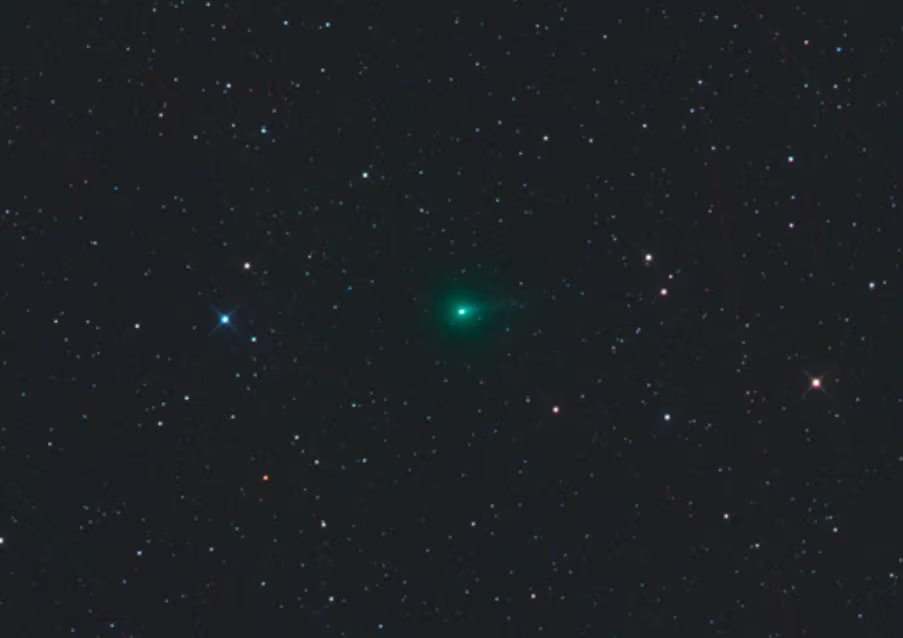
Analyzing the Passage of Comet 3I/ATLAS: A Fragmented Interstellar Visitor
In the spring of 2020, the astronomical community was captivated by 3I/ATLAS (officially designated C/2019 Y4), only the second interstellar object ever detected passing through our solar system. Discovered by the ATLAS (Asteroid Terrestrial-impact Last Alert System) survey in late 2019, the comet promised a rare spectacle as it approached its closest point to the Sun, or perihelion. However, the event was defined not by brilliance, but by a dramatic breakup that challenged observers and provided invaluable scientific data.
Contrary to some sensational reports at the time suggesting the comet had vanished entirely, expert amateur astronomers confirmed that 3I/ATLAS did not disappear; rather, its nucleus underwent catastrophic fragmentation. This event drastically reduced its brightness, transforming it from a potentially naked-eye object into an extremely faint, diffuse target requiring powerful instruments and specialized techniques for detection.
The Dramatic Fragmentation of C/2019 Y4
The crucial turning point for 3I/ATLAS occurred in April 2020. As the comet neared the Sun, the stresses of solar heating and tidal forces caused its icy nucleus to disintegrate into multiple smaller fragments. This fragmentation was confirmed by multiple observers using large telescopes, who noted a sudden decrease in the comet’s overall brightness and a more diffuse, elongated appearance of its coma.
This breakup is a common fate for comets, particularly those making their first close approach to the Sun, but it was particularly disappointing for those hoping to witness a major interstellar visitor. The fragmentation meant that instead of a single, bright nucleus, observers were looking for a scattered cloud of debris. The scientific value, however, increased dramatically, as the breakup provided a unique opportunity to study the internal structure of an object originating from outside our solar system.
Impact on Visibility
Before the fragmentation, predictions suggested 3I/ATLAS might reach a magnitude of +5 or even brighter, making it visible to the unaided eye under dark skies. After the breakup, the comet’s magnitude plummeted, remaining fainter than magnitude +8 even at its peak proximity. This shift placed it firmly out of reach for casual stargazers.
The Perihelion Passage and Observational Challenges
Comet 3I/ATLAS reached its perihelion—its closest approach to the Sun—around May 31, 2020. At this time, it was positioned in the northern sky, moving from the constellation Perseus toward Auriga.
Observing the faint, fragmented remnants of 3I/ATLAS required significant effort and specialized equipment, even for experienced amateur astronomers. The challenge was compounded by the fact that the comet was relatively low on the horizon for many Northern Hemisphere observers, and the brightness of the early summer sky further hindered visibility.
Requirements for Successful Observation (2020)
To successfully capture the fragmented comet near perihelion, observers needed to employ specific techniques, demonstrating the expertise required to track such a diffuse, faint target:
- Aperture: Telescopes with a minimum aperture of 10 inches (250mm) were generally required to gather enough light.
- Technique: Long-exposure photography combined with stacking (combining multiple images) was essential to pull the faint, dispersed light from the background noise.
- Location: Observation had to occur under extremely dark skies, far from light pollution.

The Enduring Scientific Significance of 3I/ATLAS
Despite its disappointing visual performance, the importance of 3I/ATLAS to planetary science cannot be overstated. As the second confirmed interstellar visitor, it offered astronomers a crucial second data point for understanding the population of objects ejected from other star systems.
Comparing Interstellar Visitors
3I/ATLAS was fundamentally different from the first interstellar object, 1I/’Oumuamua (discovered in 2017). While ‘Oumuamua was highly elongated and lacked a visible coma, suggesting an asteroidal nature, 3I/ATLAS clearly displayed cometary activity, including a coma and tail, confirming its icy composition. Its subsequent fragmentation further reinforced its volatile nature.
Studying the composition and behavior of these objects allows scientists to probe the material makeup of protoplanetary disks around other stars. The fact that 3I/ATLAS fragmented so readily suggests that interstellar comets may be composed of highly volatile ices, or perhaps that its structure was weakened by eons of exposure in interstellar space.

Key Takeaways: The Legacy of the Interstellar Comet
The journey of 3I/ATLAS through our solar system in 2020 was a short but scientifically rich event. Its legacy lies in the data gathered during its brief appearance and subsequent breakup, rather than its visual spectacle.
- Second Interstellar Object: 3I/ATLAS is confirmed as only the second interstellar object ever detected, providing vital comparative data to ‘Oumuamua.
- Cometary Nature Confirmed: Unlike ‘Oumuamua, 3I/ATLAS exhibited clear cometary activity (coma and tail).
- Fragmentation: The nucleus broke apart in April 2020, significantly reducing its brightness and making observation extremely challenging.
- Perihelion: The closest approach to the Sun occurred around May 31, 2020, with the fragmented remnants requiring large amateur telescopes (10-inch minimum) and stacking techniques for imaging.
- Scientific Value: The fragmentation provided a rare opportunity to analyze the volatile composition and structural integrity of an object born outside our solar system.
Conclusion: A Glimpse into Extraterrestrial Ices
While 3I/ATLAS failed to deliver the brilliant show many had hoped for, its brief visit and subsequent demise offered astronomers a profound opportunity. It confirmed that the interstellar medium is populated by icy, volatile comets, not just asteroid-like fragments. The data collected during its 2020 perihelion passage continues to inform models of stellar system formation and the dynamics of galactic object exchange, ensuring that this fragmented visitor remains a critical chapter in the study of objects from beyond our cosmic neighborhood.
Original author: David Dickinson
Originally published: October 28, 2025
Editorial note: Our team reviewed and enhanced this coverage with AI-assisted tools and human editing to add helpful context while preserving verified facts and quotations from the original source.
We encourage you to consult the publisher above for the complete report and to reach out if you spot inaccuracies or compliance concerns.