A Cosmic Portrait: The Elephant Trunk Nebula Revealed
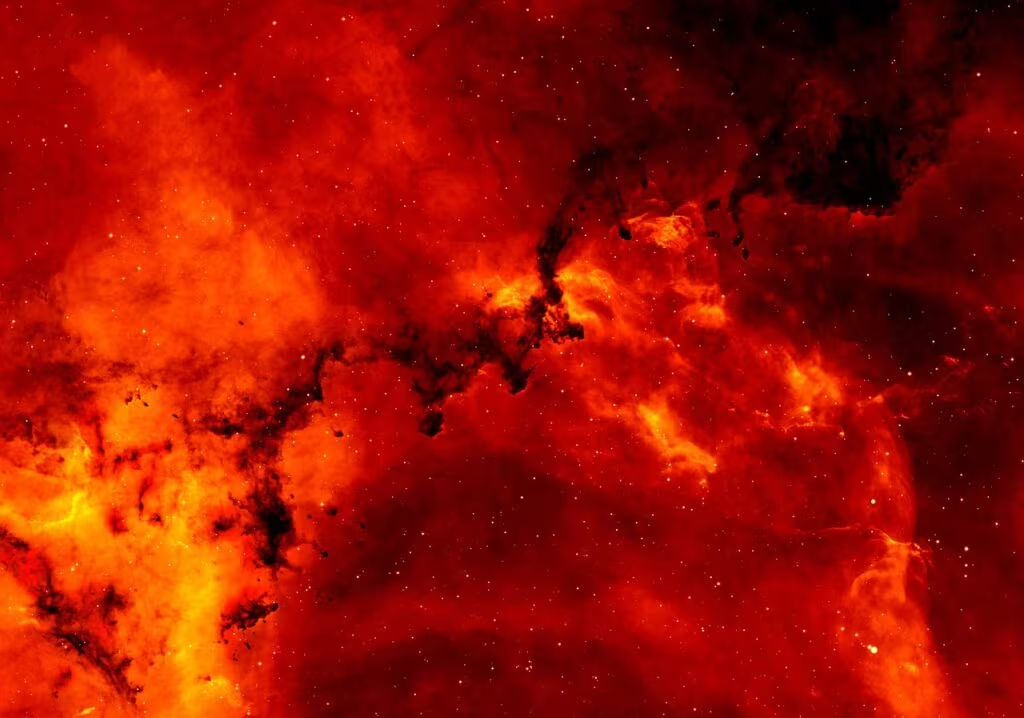
Astrophotographer Terry Hancock has successfully captured a breathtaking, high-resolution portrait of one of the cosmos’s most recognizable features: the Elephant Trunk Nebula, officially known as IC 1396. Located in the constellation Cepheus, this vast star-forming region, situated approximately 2,400 light-years from Earth, is a dramatic display of cosmic creation and destruction, rendered in stunning detail through Hancock’s specialized imaging techniques.
Hancock’s image is a testament to the power of modern amateur astrophotography, revealing the delicate interplay of glowing ionized gas and dense, dark dust clouds that characterize this stellar nursery. The resulting photograph not only serves as a beautiful piece of astronomical art but also provides a clear view of the dynamic processes driving star birth across the galaxy.
Unveiling IC 1396: Anatomy of a Star Nursery
The Elephant Trunk Nebula is part of a much larger, sprawling emission nebula complex, IC 1396, which spans hundreds of light-years. The ‘trunk’ itself is a dense, elongated pillar of gas and dust, dark against the background glow of surrounding hydrogen.
The Role of Photoevaporation
The iconic shape of the nebula is not accidental; it is sculpted by intense stellar radiation. The primary force shaping the trunk is photoevaporation, a process driven by a massive, hot, and luminous star known as HD 206267. This star, which lies just outside the core of the nebula’s main structure, emits powerful ultraviolet (UV) radiation.
This radiation systematically erodes the less dense material surrounding the pillar, leaving behind the denser, more resistant columns of gas and dust. These dense columns are where new stars are actively forming, shielded from the destructive UV light by the material itself. The Elephant Trunk Nebula is therefore a prime example of a pillar of creation, similar in structure and function to the famous Pillars of Creation in the Eagle Nebula (M16).
Key Characteristics of IC 1396
- Classification: Emission Nebula (H II region).
- Location: Constellation Cepheus, near the border with Lacerta.
- Distance: Approximately 2,400 light-years away.
- Energy Source: Ionized primarily by the massive star HD 206267.
- Significance: A region of intense star formation, containing young stellar objects (YSOs) and protostars.
The Art and Science of Deep-Sky Imaging
Capturing an object as faint and distant as IC 1396 requires not only specialized equipment but also a deep understanding of astronomical imaging techniques. Terry Hancock is renowned for his expertise in this field, particularly his use of narrow-band filtering.
Unlike standard color photography, which captures light across the visible spectrum (broadband), narrow-band imaging isolates specific wavelengths of light emitted by different elements within the nebula. This technique allows astrophotographers to cut through light pollution and highlight the chemical composition of the cosmic clouds.
Narrow-Band Technique Explained
Hancock’s image likely utilizes the ‘Hubble Palette’ or a similar mapping scheme, where specific elemental emissions are assigned to the primary red, green, and blue (RGB) channels of the final image. This process transforms the data into the vibrant, often surreal colors seen in deep-sky photographs:
- Sulfur II (S II): Often mapped to the Red channel.
- Hydrogen-alpha (Hα): Often mapped to the Green channel (Hydrogen is the most abundant element in nebulae).
- Oxygen III (O III): Often mapped to the Blue channel.
By collecting hours of data through each filter—sometimes over multiple nights—Hancock was able to gather enough light to resolve the fine, intricate dust structures and the subtle variations in gas density that define the Elephant Trunk.

“The challenge with objects like IC 1396 is the sheer scale and the faintness of the light reaching us,” explains one expert in astronomical imaging. “Hancock’s success lies in his meticulous data collection and processing, which brings out details that would be invisible to the naked eye or standard photography.”
Astronomical Significance and Future of the Nebula
Nebulae like the Elephant Trunk are transient phenomena. The very stars they create are also destined to destroy them. The intense radiation from young, massive stars like HD 206267 is slowly but surely evaporating the surrounding gas and dust.
This process of photoevaporation has two major consequences:
- Star Formation Trigger: The compression of the dense pillars by the external radiation can sometimes trigger the collapse of internal knots of gas, accelerating the birth of new stars.
- Eventual Dissipation: Over millions of years, the radiation will completely disperse the remaining gas and dust, halting star formation in this specific region and leaving behind a cluster of newly formed stars.
Studying these pillars provides astronomers with critical data on the initial conditions of star formation and helps refine models of stellar evolution. The detailed images captured by astrophotographers like Hancock serve as valuable visual records for both the scientific community and the public, illustrating the dynamic and often violent life cycle of stars.
Key Takeaways
Terry Hancock’s stunning capture of the Elephant Trunk Nebula (IC 1396) offers several important insights:
- The Subject: IC 1396 is an emission nebula and star-forming region located 2,400 light-years away in the constellation Cepheus.
- The Shape: The iconic ‘trunk’ structure is formed by photoevaporation, where intense radiation from a nearby massive star erodes surrounding, less dense material.
- The Technique: The image achieves its remarkable detail and vibrant color through narrow-band filtering, which isolates light from hydrogen, sulfur, and oxygen.
- Scientific Value: These images help astronomers study the process of star formation within dense pillars and the destructive effects of stellar radiation.
- The Photographer: Terry Hancock is recognized for his expertise in deep-sky astrophotography, delivering images that blend scientific accuracy with artistic beauty.
Original author: Anthony Wood
Originally published: November 9, 2025
Editorial note: Our team reviewed and enhanced this coverage with AI-assisted tools and human editing to add helpful context while preserving verified facts and quotations from the original source.
We encourage you to consult the publisher above for the complete report and to reach out if you spot inaccuracies or compliance concerns.