
Unexplained Lights in the Sky: A Terrestrial Explanation for Cold War Phenomena
A new scientific analysis suggests that many reports of mysterious lights and Unidentified Anomalous Phenomena (UAPs)—historically known as UFOs—during the 1940s and 1950s may have a surprisingly terrestrial origin: the massive program of atmospheric nuclear testing conducted by global powers during the early Cold War era.
This finding, derived from a rigorous examination of archival sighting reports and historical nuclear test data, establishes a compelling correlation between the timing and location of these powerful detonations and the subsequent appearance of unexplained aerial events. For decades, these lights have fueled speculation, but researchers now propose that the sheer energy released by these tests created atmospheric disturbances that manifested as visible, yet non-extraterrestrial, phenomena.
The Study’s Core Discovery: Correlation in Time and Space
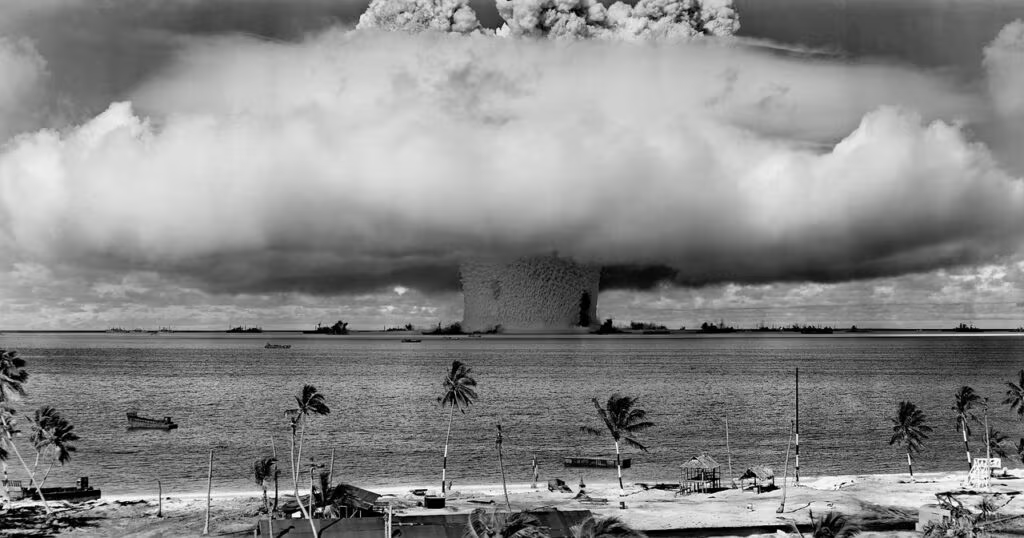
The study focused specifically on the period following World War II, when the United States, the Soviet Union, and other nations began testing nuclear weapons above ground. This era, spanning roughly 1945 to 1963, coincided precisely with the explosion of the ‘flying saucer’ craze and the peak of early UAP reporting.
Researchers analyzed historical records, correlating known nuclear test schedules—including the exact dates, times, and locations of detonations—with contemporaneous reports of unusual aerial activity. The results indicated a significant statistical overlap.
Key Findings from the Archival Analysis:
- Geographic Overlap: UAP reports often clustered geographically near major nuclear test sites, such as those in the American Southwest (Nevada Test Site) and the Pacific Proving Grounds.
- Temporal Proximity: Spikes in sightings frequently occurred immediately following large-scale atmospheric detonations, suggesting a direct cause-and-effect relationship, or at least a strong trigger mechanism.
- Phenomena Description: The descriptions of the lights—often fast-moving, erratic, or exhibiting unusual colors—are consistent with known atmospheric effects caused by powerful shockwaves and electromagnetic pulses.
This correlation provides a strong, physics-based explanation for a significant subset of historical UAP cases that have long defied conventional identification.
The Physics of the Phenomenon: How a Blast Creates a Light Show
To understand the link, one must consider the sheer scale of energy released during an atmospheric nuclear explosion. Unlike underground tests, these surface and air bursts injected massive amounts of energy, heat, and ionized particles directly into the atmosphere, creating several potential mechanisms for visual phenomena:
1. Ionization and Plasma Effects
The intense heat and radiation from a nuclear blast instantly ionize the surrounding air, creating a superheated plasma bubble. As this bubble expands and dissipates, the ionized particles can interact with the Earth’s magnetic field and atmospheric layers. This interaction could generate visible light, similar to an aurora, but localized and induced by the blast.
2. Electromagnetic Pulses (EMP)
Nuclear detonations produce powerful Electromagnetic Pulses (EMP). These pulses can travel vast distances and induce currents in the atmosphere and ground infrastructure. While the primary effect of EMP is on electronics, the energy transfer itself could temporarily excite atmospheric gases, leading to transient, glowing effects observed far from the blast site.
3. Atmospheric Shockwaves
The physical shockwave from a large nuclear explosion travels through the atmosphere, creating density variations. These variations can refract light, causing distant observers to see distorted or rapidly moving light sources, or even generating visible shock fronts that appear as fast-moving, non-conventional objects.
“The energy output of these early atmospheric tests was unprecedented in human history. It is entirely plausible that these massive disruptions generated secondary atmospheric effects that observers, unfamiliar with the physics of nuclear blasts, interpreted as novel aerial craft or unexplained lights,” the researchers noted in their findings.

Historical Context: The Rise of the Flying Saucer
The timing of this correlation is crucial. The first widely publicized sighting that kicked off the modern UFO era—Kenneth Arnold’s 1947 sighting of nine objects near Mount Rainier—occurred just two years after the Trinity test, the first nuclear detonation. The subsequent decade saw the rapid escalation of both nuclear testing and public fascination with flying saucers.
During the 1950s, the Cold War climate meant that the public was highly sensitized to military technology, secret projects, and potential threats from the Soviet Union. This environment created a perfect storm where unusual atmospheric phenomena—whether caused by nuclear tests, weather balloons, or early experimental aircraft—were readily interpreted through the lens of advanced, unknown technology.
This study provides critical context for projects like Project Blue Book, the U.S. Air Force investigation into UFOs, which struggled to categorize many of the visually ambiguous reports from this period. The findings suggest that a significant portion of the “unidentified” cases from the 1940s and 50s likely had a classified, albeit terrestrial, military origin—the nuclear weapons program.
Implications for Modern UAP Research
While this study focuses on historical sightings, it offers valuable methodology for contemporary UAP investigations. By systematically ruling out known, large-scale human activities—even those with highly unusual physical consequences—scientists can narrow the focus of current research.
What This Study Does Not Claim:
- It does not debunk all UAPs. The study specifically addresses phenomena from the peak atmospheric testing era (1940s–1950s). Modern UAP reports, particularly those involving advanced sensor data, require separate analysis.
- It is a correlation, not necessarily causation in every case. However, the statistical link is strong enough to warrant classifying these historical sightings under a terrestrial, military-induced atmospheric phenomenon.
By providing a robust, physics-based explanation for these early, mysterious lights, the research helps separate genuine unknowns from phenomena rooted in Cold War military activity.
Key Takeaways
This analysis of historical data provides a significant step toward understanding the origins of the earliest UAP reports, grounding them in the dramatic technological shifts of the mid-20th century.
- The Link: A strong correlation exists between the timing and location of atmospheric nuclear tests (1945–1963) and spikes in reports of mysterious aerial lights.
- The Mechanism: The massive energy release, shockwaves, and Electromagnetic Pulses (EMP) from nuclear detonations likely caused visible atmospheric ionization or light refraction effects.
- Historical Context: The rise of the “flying saucer” phenomenon in the 1950s coincided directly with the most intensive period of above-ground nuclear testing.
- Research Value: The findings offer a terrestrial, physics-based explanation for a substantial number of historical UAP sightings, helping to refine the scope of ongoing UAP investigations.
Moving Forward
This research underscores the importance of historical context when evaluating unexplained phenomena. As governments continue to declassify records related to both UAPs and Cold War military programs, a clearer picture emerges, suggesting that many of the most perplexing aerial events of the past were, in fact, side effects of humanity’s own technological advances. Future research will likely focus on modeling the exact atmospheric effects of specific historical blasts to definitively match them with detailed sighting reports, further solidifying this terrestrial explanation.
Original author: Michelle Starr
Originally published: October 28, 2025
Editorial note: Our team reviewed and enhanced this coverage with AI-assisted tools and human editing to add helpful context while preserving verified facts and quotations from the original source.
We encourage you to consult the publisher above for the complete report and to reach out if you spot inaccuracies or compliance concerns.