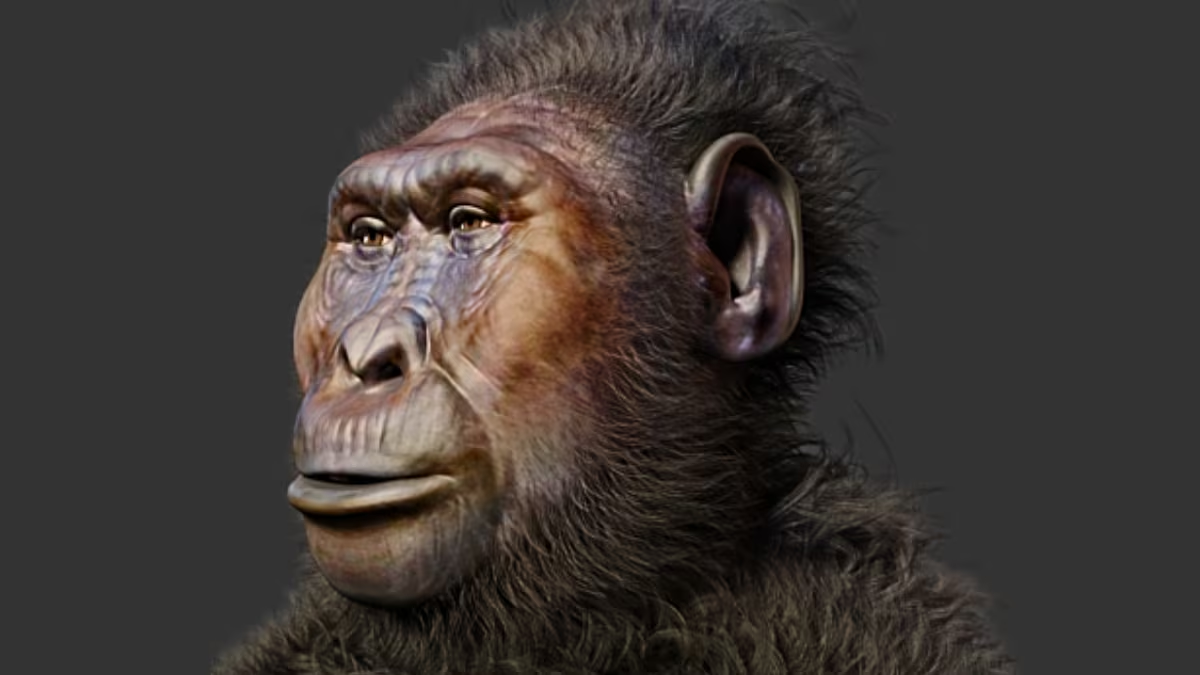
Dual Adaptation: New Fossils Reshape the Story of Paranthropus boisei
New analysis of rare hand fossils belonging to the extinct human relative, Paranthropus boisei, has revealed a surprising combination of anatomical features. These findings challenge long-held assumptions about the lifestyle of this robust hominin, suggesting it possessed both the powerful, gorilla-like grip needed for climbing and the precision required for sophisticated tool use.
P. boisei, often nicknamed the “Nutcracker Man” due to its massive jaws and teeth, lived in East Africa approximately 2.3 to 1.2 million years ago. For decades, paleoanthropologists viewed this species primarily as a specialized, ground-dwelling vegetarian. The discovery of these hand bones, however, paints a picture of a far more versatile and complex creature.
The Anatomy of a Contradiction: Power and Precision
The research focused on specific bones within the hand structure, which provided clear evidence of dual adaptation. Typically, species specialized for powerful arboreal (tree) locomotion—like modern gorillas—develop features that compromise the fine motor skills necessary for precision gripping. Conversely, species focused on tool manufacture, like early Homo, lose the robust adaptations for climbing.
P. boisei appears to have retained both capabilities simultaneously. The key anatomical findings include:
- Gorilla-like Power: The structure of the metacarpals (the bones in the palm) and the robust nature of the hand suggest immense gripping strength, likely used for suspensory locomotion (hanging from branches) and powerful grasping, similar to modern great apes.
- Human-like Precision: Crucially, the fossils also show characteristics in the distal phalanges (fingertips) and the thumb joint that are consistent with the precision grip seen in humans. This grip, where the thumb can accurately oppose the fingertips, is essential for manipulating small objects and manufacturing complex stone tools.
This blend of traits suggests that P. boisei was capable of spending significant time in trees while also possessing the dexterity to engage in activities previously thought to be exclusive to the Homo lineage.
Reimagining the ‘Nutcracker Man’
Paranthropus boisei belongs to the robust australopithecines—a side branch of the human evolutionary tree that eventually went extinct. They are characterized by their extreme dietary specialization, evidenced by their massive chewing apparatus. The traditional narrative positioned them as evolutionary dead ends, highly specialized for crushing tough foods.
This new evidence forces a re-evaluation of that specialization. If P. boisei was capable of manufacturing and using stone tools, it significantly complicates the timeline of technological development in early hominins.
“The hand fossils indicate that P. boisei was not simply a robust grazer confined to the ground,” noted the researchers. “It was a creature capable of navigating complex arboreal environments while simultaneously utilizing the dexterity necessary for tool use, blurring the lines we previously drew between different hominin genera.”
Tool Use Beyond the Homo Genus
Before this discovery, the ability to create and use sophisticated tools (specifically Oldowan tools) was strongly associated with the genus Homo (e.g., Homo habilis). While some evidence suggested Paranthropus might have used existing tools, the anatomical evidence for tool manufacture was lacking.
If P. boisei had the necessary hand anatomy for precision grip, it suggests two major possibilities:
- Independent Evolution: The precision grip evolved independently in both the Paranthropus and Homo lineages, driven by environmental pressures or shared ancestral traits.
- Shared Ancestry: The common ancestor of Paranthropus and Homo already possessed the anatomical foundation for both powerful climbing and precision grip, and these traits were retained by P. boisei while being lost or minimized in other robust forms.
This finding supports the growing consensus that the early hominin landscape was far more diverse and complex than previously imagined, with multiple species potentially utilizing similar technologies and ecological niches.
Key Takeaways for Human Evolution
This rare fossil evidence provides crucial insights into the functional morphology of early hominin hands and their behavior:
- Challenging Specialization: P. boisei was not solely a specialized ground-dweller; it maintained significant arboreal capabilities alongside terrestrial activities.
- Redefining Dexterity: The ability to perform a human-like precision grip was present in a hominin lineage previously thought to be too robust and specialized for fine motor skills.
- Broader Tool Use: The anatomical capacity for tool manufacture may have been widespread among early hominins, not restricted to the ancestors of modern humans.
- Complex Ecology: P. boisei likely had a highly flexible ecological strategy, utilizing both forest canopy resources (climbing) and open savanna resources (tool use for processing food or defense).
Conclusion: A More Nuanced Evolutionary Tree
The discovery of these dual-purpose hands on the “Nutcracker Man” underscores the importance of fossil evidence in continually refining our understanding of human evolution. The evolutionary path was not a straight line toward modern humans, but a dense, branching bush where multiple species experimented with different combinations of traits—some leading to specialized diets, others to increased dexterity, and in the case of P. boisei, a surprising blend of both the powerful gorilla and the precise tool-maker. This complexity highlights the need for continued investigation into the functional morphology of extinct hominins to truly map the origins of human behavior.
What’s Next
Future research will likely focus on finding associated stone tools at sites where P. boisei remains are prevalent. Confirming the direct association between these hand fossils and manufactured artifacts would solidify the hypothesis that this robust hominin was an active tool-maker, further complicating the narrative of technological dominance by the Homo genus during the Early Pleistocene period.
Original author: The Conversation
Originally published: October 28, 2025
Editorial note: Our team reviewed and enhanced this coverage with AI-assisted tools and human editing to add helpful context while preserving verified facts and quotations from the original source.
We encourage you to consult the publisher above for the complete report and to reach out if you spot inaccuracies or compliance concerns.