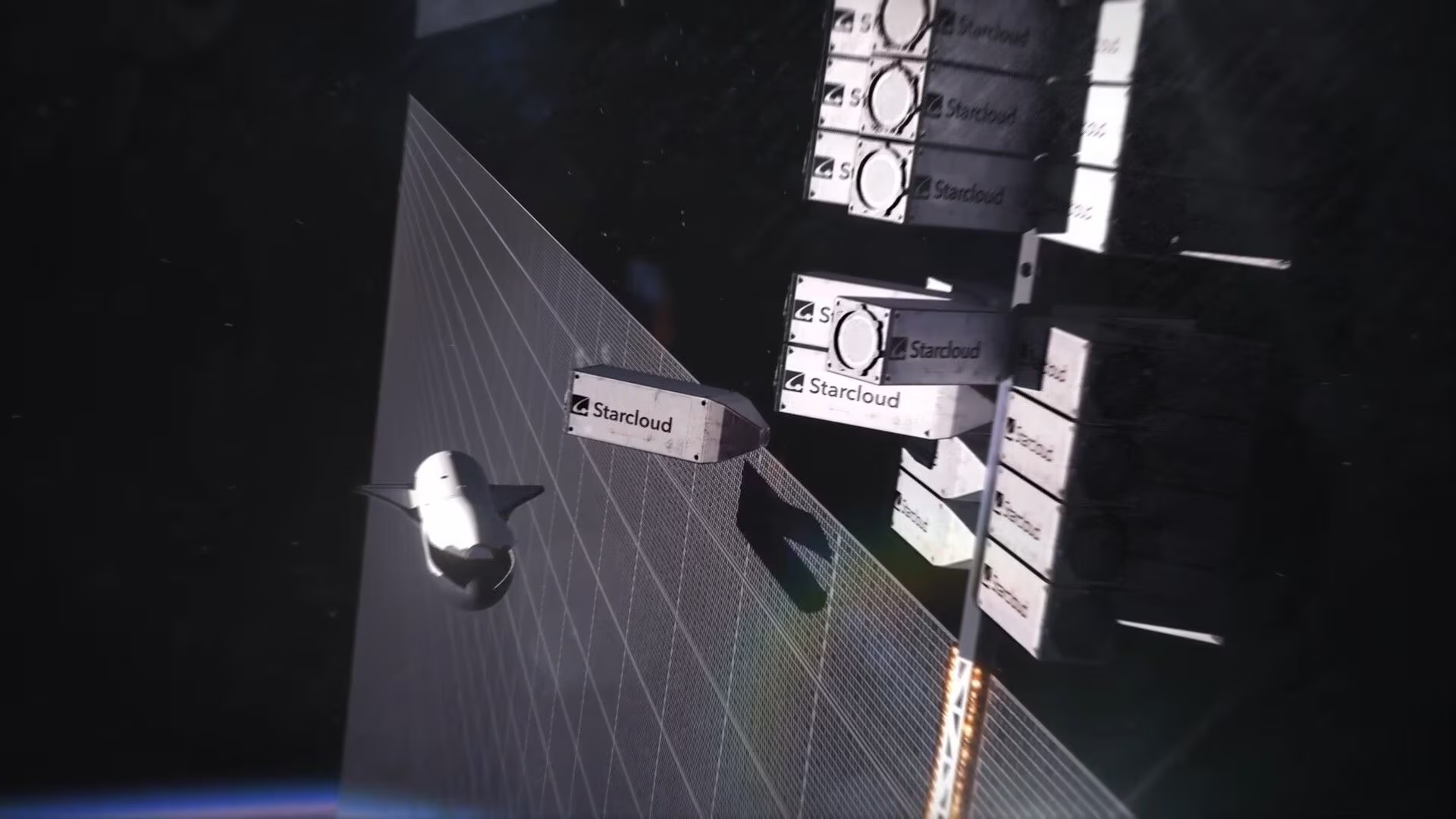
NVIDIA H100 GPU Prepares for Record-Setting Orbital Launch
In a significant step toward establishing high-performance computing infrastructure beyond Earth, a powerful NVIDIA H100 GPU is scheduled to launch into orbit next month. This mission marks the orbital debut of one of the world’s most advanced commercial graphics processing units, designed primarily for massive artificial intelligence (AI) workloads on Earth.
The deployment is a crucial test for the feasibility of operating high-density, commercial-grade data centers in the harsh environment of space. If successful, this initiative could fundamentally change how complex data processing, real-time AI analysis, and large-scale simulations are conducted for future space missions and terrestrial applications.
The Mission: Testing the Limits of Space-Based Data Centers
The launch is part of a broader effort to validate the performance and resilience of cutting-edge commercial off-the-shelf (COTS) technology in the final frontier. Traditionally, space hardware relies on specialized, radiation-hardened processors, which are significantly slower and less powerful than their commercial counterparts.
The NVIDIA H100 GPU, based on the Hopper architecture, is a powerhouse optimized for accelerating large language models and complex scientific simulations. The original article notes that the H100 is about 100 times more powerful than many existing space-qualified processors, making its successful operation in orbit a potential game-changer for computational capacity in space.
Why High-Performance Computing is Moving Off-World
The primary goal of placing high-performance GPUs in orbit is to enable edge computing for space assets. Instead of transmitting massive raw data streams back to Earth for processing—a time-consuming and bandwidth-intensive process—data can be analyzed and compressed directly in space.
This capability is essential for several emerging applications:
- Real-Time Satellite Imagery Analysis: Rapidly identifying objects, tracking weather patterns, or monitoring environmental changes without latency.
- Autonomous Navigation and Robotics: Providing the computational power needed for complex decision-making by deep-space probes or orbital maintenance robots.
- Scientific Simulations: Running complex physics and materials science experiments in microgravity environments that require immense computational throughput.
Overcoming the Challenges of Space
Deploying a commercial chip like the H100 in orbit presents immense engineering hurdles. Unlike ruggedized space hardware, the H100 was designed for climate-controlled terrestrial data centers. The orbital environment introduces two major threats:
- Radiation: High levels of cosmic and solar radiation can cause single-event upsets (SEUs) or permanent damage to sensitive electronics, leading to data corruption or hardware failure.
- Thermal Management: The vacuum of space makes traditional air cooling impossible, while the constant cycling between direct sunlight and deep shadow creates extreme temperature fluctuations that must be managed by sophisticated liquid cooling and heat dissipation systems.
Engineers must implement specialized shielding, error correction codes (ECC), and advanced cooling solutions to ensure the H100 can maintain operational stability and integrity during its mission.
Implications for AI and the New Space Economy
This orbital debut is more than just a technology demonstration; it represents a strategic shift in the burgeoning New Space economy. By proving that commercial, high-density computing hardware can function reliably in orbit, the cost and complexity of future space missions could be drastically reduced.
Access to powerful GPUs in space accelerates the development of advanced AI applications that were previously confined to Earth. This capability supports the trend toward distributed computing, where processing power is placed closer to the data source, whether that source is a satellite constellation or a lunar habitat.
Furthermore, the success of this mission could pave the way for dedicated commercial orbital data centers, offering computing services to governments, research institutions, and private companies globally. This would establish a new tier of cloud computing infrastructure, leveraging the unique advantages of the space environment.
Key Takeaways and What Comes Next
The launch of the NVIDIA H100 GPU is a critical milestone in the convergence of AI technology and space exploration.
- Technological Leap: The H100 offers computational power approximately 100 times greater than many existing space-qualified systems, enabling complex AI tasks in orbit.
- Core Objective: The mission aims to validate the use of high-performance commercial off-the-shelf (COTS) hardware in space, reducing reliance on expensive, slower, radiation-hardened chips.
- Engineering Focus: Success hinges on specialized systems designed to mitigate the severe challenges of radiation exposure and thermal management in the orbital environment.
- Future Impact: This test is foundational for developing space-based data centers and enabling high-speed edge computing for future satellite constellations and deep-space missions.
Following the launch next month, the initial phase will involve rigorous testing of the GPU’s performance under operational conditions. Data gathered on error rates, thermal stability, and computational throughput will determine the viability of scaling up orbital data center infrastructure in the coming years. This pioneering effort sets the stage for a future where the cloud truly extends into space.
Original author: Tereza Pultarova
Originally published: October 23, 2025
Editorial note: Our team reviewed and enhanced this coverage with AI-assisted tools and human editing to add helpful context while preserving verified facts and quotations from the original source.
We encourage you to consult the publisher above for the complete report and to reach out if you spot inaccuracies or compliance concerns.