A Rare Glimpse into Planet Formation Around Low-Mass Stars
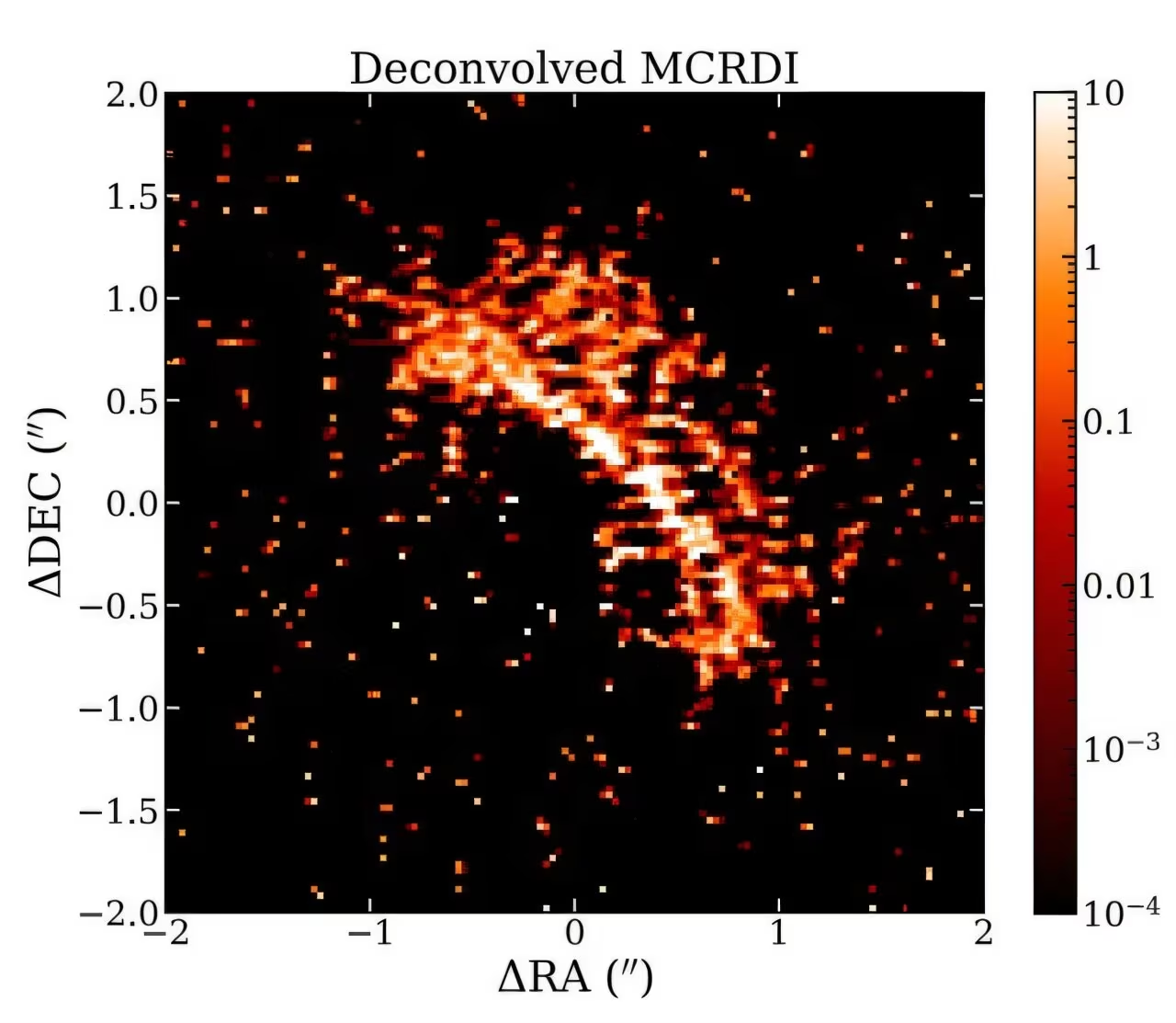
An international team of astronomers, leveraging the unparalleled infrared capabilities of the James Webb Space Telescope (JWST), has made a significant discovery concerning the formation of planetary systems. They have identified a large, cold debris disk orbiting the nearby M-dwarf star TWA 20.
This finding is particularly noteworthy because large debris disks are rarely observed around M-dwarf stars, which are the most common type of star in the Milky Way. The detection, made using JWST’s Mid-Infrared Instrument (MIRI), provides crucial new insights into how planetesimals—the building blocks of planets—can efficiently form and survive even in the environments of these low-mass stellar systems.

TWA 20: A Young Star in the TW Hydrae Association
To understand the significance of the debris disk, it is essential to contextualize its host star, TWA 20. This star is classified as an M-dwarf, often referred to as a red dwarf, meaning it is significantly smaller and less massive than our Sun.
Key characteristics of the TWA 20 system:
- Location: TWA 20 is relatively close to Earth, situated approximately 55 parsecs away (about 180 light-years). This proximity makes it an excellent target for detailed observation.
- Stellar Group: It belongs to the TW Hydrae association, a group of young stars that share a common origin and motion through space. This association is a prime laboratory for studying the early stages of stellar and planetary evolution.
- Age: The star is estimated to be quite young, with an age ranging between 7 and 15 million years. This places it firmly in the transition period where the initial, gas-rich protoplanetary disk has dissipated, and the debris disk phase—characterized by collisions of larger bodies—is underway.
The Difference Between Protoplanetary and Debris Disks
For readers unfamiliar with stellar evolution, it is important to distinguish between the two primary disk types observed around young stars:
- Protoplanetary Disks: These are massive, gas-rich structures present in the first few million years of a star’s life. Planets form within these disks.
- Debris Disks: These are much thinner, dust-poor structures that appear after the gas has dissipated. The dust in a debris disk is secondary, generated by the grinding collisions of larger, already-formed bodies called planetesimals (like asteroids and comets).
The discovery of a debris disk around TWA 20 confirms that the system has moved past the initial planet-forming stage and is now in the collisional phase, where the remnants of planet formation are interacting.
Unpacking the Discovery: A Cold, Vast Disk
The international team, whose findings were reported in a paper led by Grant M. Kennedy of the University of Warwick, utilized JWST’s superior sensitivity to detect the faint thermal emission from the cold dust surrounding TWA 20.
The observations revealed a debris disk with striking characteristics:
- Size: The disk is large, extending to a radius of approximately 15 astronomical units (AU). For context, 1 AU is the distance between the Earth and the Sun. This size is comparable to the orbit of Uranus in our solar system.
- Temperature: The dust in the disk is exceptionally cold, measured at an estimated temperature of only 47 Kelvin (K). This is equivalent to about -226 degrees Celsius or -375 degrees Fahrenheit.
This combination of large size and low temperature is highly unusual for an M-dwarf. Previous surveys, often limited by the sensitivity of older instruments, struggled to detect such cold, faint dust around these low-luminosity stars.

Why M-Dwarfs Pose a Challenge
M-dwarfs are much dimmer and cooler than Sun-like stars. Consequently, the dust orbiting them receives less stellar heating, making the resulting debris disks colder and fainter. Detecting this cold dust requires instruments like MIRI, which are optimized for the mid-infrared spectrum where the thermal emission from 47 K dust peaks.
The fact that the disk is so large (15 AU) is significant. In low-mass systems, the gravitational influence and available material are often thought to be concentrated closer to the star. Finding a robust debris disk extending so far out suggests that the process of building planetesimals—the necessary step before forming rocky or icy planets—was efficient even in the outer, colder reaches of the TWA 20 system.
Implications for Planet Formation Theories
This discovery has profound implications for our understanding of exoplanet formation, particularly around the most numerous stars in the galaxy.
Efficiency of Planetesimal Formation
One of the central questions in astrophysics is whether planet formation is universally efficient across different stellar masses. The detection of a large debris disk around TWA 20 suggests a positive answer.
- Challenging Assumptions: Historically, models sometimes suggested that the low mass and weaker gravity of M-dwarfs might hinder the rapid growth of planetesimals necessary to survive the dissipation of the initial gas disk.
- Evidence of Collisions: The presence of a substantial debris disk, generated by continuous collisions, confirms that a large population of planetesimals—likely icy bodies similar to those in our Kuiper Belt—must have formed and currently exist in the TWA 20 system.
Connecting to Exoplanet Surveys
M-dwarfs are prime targets for exoplanet searches, as stars like TRAPPIST-1 host multiple Earth-sized worlds. While the planets found around M-dwarfs are typically close-in (within 0.1 AU), the TWA 20 debris disk suggests that these systems also possess substantial reservoirs of material further out.

This finding supports the idea that M-dwarf systems are not just capable of forming small, rocky planets in their habitable zones, but also possess the necessary material to form larger, icy bodies or even gas giants further away, provided the initial conditions were favorable.
Key Takeaways and Next Steps
The JWST observation of TWA 20 marks a critical step in mapping the diversity of planetary nurseries across the galaxy. The ability of JWST to detect such cold, faint structures is opening up new avenues of research that were previously impossible.
Summary of the TWA 20 Debris Disk Discovery:
- Host Star: TWA 20, a young M-dwarf (red dwarf) star.
- Instrument: JWST’s MIRI, sensitive to mid-infrared light.
- Disk Type: Large, cold debris disk (secondary dust from collisions).
- Key Dimensions: Radius of 15 AU and temperature of 47 Kelvin.
- Significance: Confirms efficient formation of planetesimals around low-mass stars, challenging previous limitations.
Future Research
Astronomers plan to use these initial findings to guide future JWST observations. By studying more M-dwarf systems in detail, researchers hope to determine the frequency and characteristics of these distant debris disks. This will help refine models of planet formation and better predict where to look for distant, potentially icy exoplanets in these common stellar systems. The goal is to establish whether the TWA 20 disk is an outlier or representative of a common evolutionary path for M-dwarf planetary systems.
Original author: Tomasz Nowakowski
Originally published: October 28, 2025
Editorial note: Our team reviewed and enhanced this coverage with AI-assisted tools and human editing to add helpful context while preserving verified facts and quotations from the original source.
We encourage you to consult the publisher above for the complete report and to reach out if you spot inaccuracies or compliance concerns.