The Hunt for Cosmic Dawn: Capotauro Challenges Early Universe Models
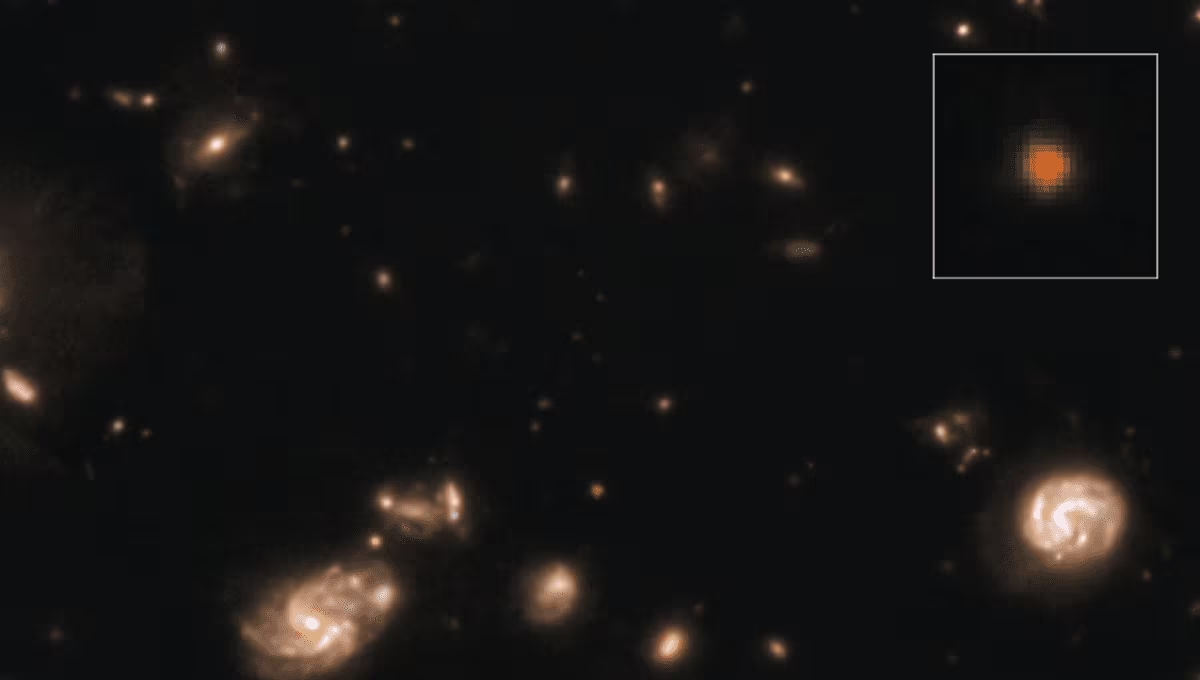
The James Webb Space Telescope (JWST) continues to rewrite the history of the cosmos. Astronomers are currently analyzing a remarkable detection, an object informally dubbed Capotauro (also known as JADES-GS-z14-0), which presents a compelling case for being the most distant—and therefore the oldest—galaxy ever observed. If confirmed, this discovery would push the timeline for the formation of the first large stellar structures significantly earlier than predicted by current cosmological models.
This finding is generating intense discussion within the astronomical community because Capotauro is not just old; it is surprisingly bright and massive for an object existing so early in the universe’s history. While the initial detection is based on photometric data, the implications are profound, suggesting that star formation began with unexpected speed and vigor during the universe’s infancy.
Understanding the Significance of Extreme Redshift
To understand why Capotauro is such a potential record-breaker, it is essential to grasp the concept of redshift (z). As the universe expands, light traveling across vast cosmic distances is stretched, shifting its wavelength toward the red end of the spectrum. The higher the redshift value (z), the farther away the object is, and the further back in time we are observing it.
Capotauro’s estimated redshift is exceptionally high, placing it deep within the Epoch of Reionization—the period when the first stars and galaxies began to form and ionize the neutral hydrogen gas that filled the early universe. Previous JWST discoveries have already identified galaxies with high redshifts (e.g., z ≈ 13), but Capotauro appears to surpass these records, potentially reaching a redshift value that places it extremely close to the Big Bang.
The Puzzle of Capotauro’s Luminosity
What truly sets Capotauro apart is its sheer luminosity. Objects from the early universe are expected to be small, dim, and difficult to detect. Capotauro, however, is remarkably bright, suggesting it is already quite massive, containing a significant population of stars.
This brightness implies that the processes of star formation and galaxy assembly were highly efficient almost immediately after the Big Bang. This challenges the standard $Lambda$CDM (Lambda Cold Dark Matter) model, which generally predicts a more gradual buildup of stellar mass in the first few hundred million years.
The Critical Need for Spectroscopic Confirmation
While the photometric data (measuring brightness across different filters) strongly suggests Capotauro’s extreme distance, astronomers require spectroscopic confirmation to finalize the claim. Spectroscopic analysis involves splitting the light into a detailed spectrum, allowing scientists to measure the exact redshift based on the characteristic spectral lines of elements like hydrogen and oxygen.
This distinction is crucial for scientific trustworthiness and accuracy:
- Photometric Redshift: An estimate based on the object’s color profile across several filters. This can sometimes be ambiguous, as a closer, highly reddened object might mimic the light profile of a very distant, high-redshift object.
- Spectroscopic Redshift: A definitive, precise measurement of the object’s distance and age, considered the gold standard in cosmology.
If JWST’s Near-Infrared Spectrograph (NIRSpec) can successfully obtain a definitive spectrum for Capotauro, confirming its high redshift, it would solidify its place as the oldest known galaxy and provide unprecedented insight into the Cosmic Dawn.
“The brightness of this object is astonishing given its presumed age. If the spectroscopic redshift confirms our photometric estimates, we are looking at a structure that formed stars far faster than our current models allow, forcing a re-evaluation of early galaxy formation physics.”
Implications for Galaxy Formation Theory
If Capotauro is confirmed as the universe’s first galaxy, the implications extend far beyond setting a new distance record. It would fundamentally challenge our understanding of several key processes:
- Star Formation Efficiency: It suggests that the gas clouds in the early universe were able to cool and collapse into stars much more quickly and efficiently than theoretical predictions currently account for.
- Early Chemical Enrichment: The presence of heavy elements (which are created inside stars) in such an early galaxy implies that the first generation of stars (Population III stars) lived, died, and seeded the cosmos with metals very rapidly.
- Black Hole Growth: Extremely bright, distant objects can sometimes be quasars—galaxies powered by actively feeding supermassive black holes. If Capotauro is confirmed as a galaxy and not a quasar, it still provides clues about the initial seeds of structure formation. If it is a quasar, it suggests supermassive black holes formed almost instantaneously after the Big Bang, a major theoretical hurdle.
JWST, with its unparalleled infrared sensitivity, was specifically designed to observe this epoch. Discoveries like Capotauro demonstrate the telescope’s ability to probe the universe just a few hundred million years after its birth, providing the empirical data necessary to refine and potentially overhaul existing cosmological theories.
Key Takeaways: The Capotauro Discovery
- The Object: Capotauro (JADES-GS-z14-0) is a galaxy candidate detected by the JWST.
- The Claim: It is potentially the most distant and oldest galaxy ever observed, placing it near the beginning of the Epoch of Reionization.
- The Puzzle: Capotauro is surprisingly bright and massive, suggesting rapid star formation that contradicts standard cosmological models.
- The Next Step: Astronomers are awaiting spectroscopic confirmation (a precise measurement of its redshift) to verify its extreme distance.
- The Impact: If confirmed, the discovery necessitates a significant revision of theories regarding how quickly the first structures and stars formed after the Big Bang.
What’s Next in the Search for Cosmic Origins
The focus now shifts entirely to obtaining definitive spectroscopic data. The JWST team is prioritizing follow-up observations using its high-precision instruments to confirm the redshift of Capotauro. Every confirmed high-redshift galaxy provides a crucial data point, helping cosmologists map out the timeline of the universe’s structural evolution.
If Capotauro’s status as the oldest galaxy is confirmed, it will serve as a lighthouse, guiding future observations and theoretical work aimed at understanding the fundamental processes that governed the universe during its first few hundred million years.
Original author: Dr. Alfredo Carpineti
Originally published: October 21, 2025
Editorial note: Our team reviewed and enhanced this coverage with AI-assisted tools and human editing to add helpful context while preserving verified facts and quotations from the original source.
We encourage you to consult the publisher above for the complete report and to reach out if you spot inaccuracies or compliance concerns.