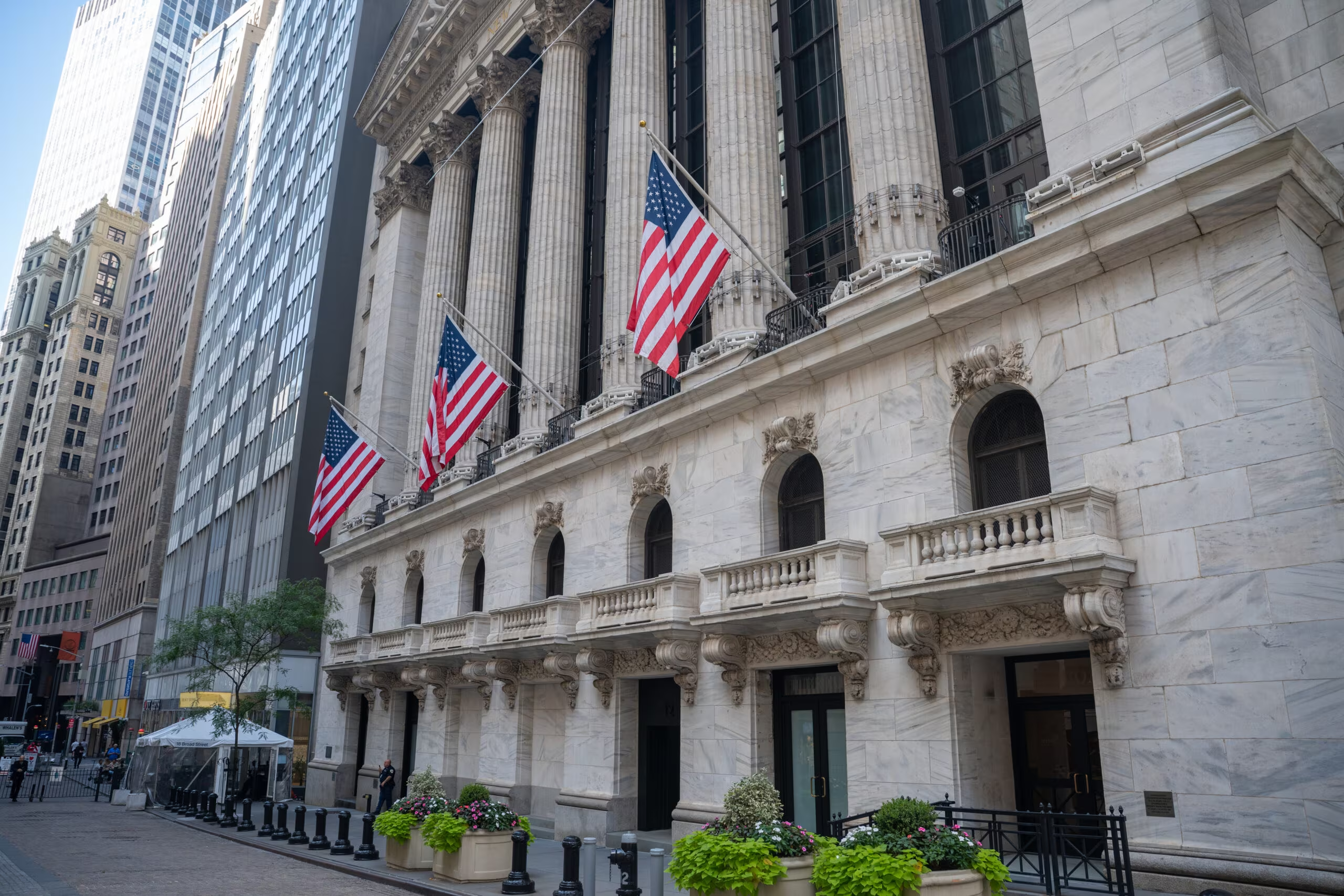
Market Rally Driven by Second Consecutive Rate Cut
Global financial markets responded positively to the Federal Reserve’s latest monetary policy decision, which saw the central bank implement its second consecutive interest rate cut. This move, aimed at ensuring a soft landing for the economy amid moderating inflation, propelled major U.S. indices higher, with the technology-heavy Nasdaq Composite leading the gains. The Dow Jones Industrial Average, the S&P 500, and the Nasdaq all finished the trading session in positive territory, reflecting investor relief and renewed appetite for growth stocks.
The market’s immediate focus was not just on the rate reduction itself—a cut of 25 basis points (bps) to the target range for the federal funds rate—but also on the forward guidance provided by Fed Chair Jerome Powell. While the cut signaled confidence in inflation control, Powell’s subsequent comments introduced a note of caution regarding the pace of future easing.
The Federal Reserve’s Decision and Forward Guidance
The Federal Open Market Committee (FOMC) justified the rate reduction by citing continued progress in bringing inflation down toward the 2% target, alongside signs of cooling in the labor market. This second cut confirmed the market’s expectation that the Fed was committed to adjusting policy proactively to avoid an unnecessary economic slowdown.
However, the enthusiasm was tempered by Chair Powell’s press conference. He stressed that the FOMC remains data-dependent and that the current economic environment necessitates flexibility. Powell specifically addressed the market’s aggressive pricing of future cuts:
“While we are pleased with the progress on inflation, the path ahead remains uncertain. I want to be clear: the prospect of another rate cut in December is far from certain and will depend entirely on the totality of incoming economic data.”
This statement served as a crucial reminder to investors that the Fed is not on a predetermined easing path. The central bank is balancing the risk of overtightening against the risk of reigniting inflationary pressures, a delicate act known as the “last mile” of disinflation.
Key factors influencing the Fed’s cautious stance include:
- Persistent Core Inflation: While headline inflation has dropped, core services inflation remains sticky.
- Labor Market Resilience: Despite some cooling, wage growth in certain sectors is still robust.
- Geopolitical Risks: External factors continue to pose potential threats to energy and supply chains.
Nvidia’s Explosive Performance: An AI Catalyst
While the broader market benefited from the lower cost of capital, the standout performer of the day was Nvidia Corporation. The semiconductor giant’s stock surged by over 5%, adding billions to its market capitalization and reinforcing its position as the dominant player in the artificial intelligence (AI) infrastructure boom.
Nvidia’s performance was driven by several converging factors:
- Rate Cut Benefit: Technology and growth stocks, which rely heavily on future earnings projections, benefit disproportionately from lower interest rates, as it reduces the cost of borrowing and increases the present value of those future profits.
- AI Infrastructure Demand: Analysts continue to upgrade forecasts based on unprecedented demand for Nvidia’s high-performance H100 and B200 GPUs, which are essential for training and deploying large language models (LLMs).
- Competitive Edge: Despite increasing competition from rivals and hyperscalers developing custom chips, Nvidia’s CUDA ecosystem maintains a powerful moat, making it difficult for customers to switch platforms.

This surge underscores the market’s conviction that the AI revolution is still in its early stages, and Nvidia remains the primary toll collector for this technological transformation.
Economic Data Uncertainty and Market Headwinds
The market session also contended with the backdrop of delayed economic data releases. A temporary government operational issue led to the postponement or impact of several scheduled reports, adding a layer of uncertainty to the economic picture.
Among the data points affected were:
- MBA Mortgage Applications: Weekly data for the period ended [Specific Date in 2025]. This release is critical for gauging housing market activity and the immediate impact of interest rate movements.
- Wholesale Inventories: The preliminary reading for [Specific Month in 2025]. This report provides insight into supply chain health and future production expectations.
While the market largely overlooked these delays, focusing instead on the Fed’s immediate action, the lack of timely data complicates the FOMC’s data-dependent approach. Investors will be closely watching for the rescheduled release of these figures, as they provide essential context for the Fed’s future decisions.
Key Takeaways for Investors
The day’s events signal a complex environment where monetary policy is easing, but future moves are highly conditional. For investors navigating this landscape, several key points stand out:
- Conditional Easing: The Fed is easing, but Chair Powell has effectively pushed back against expectations of rapid, consecutive cuts. Future policy is entirely dependent on inflation and employment data.
- Tech Resilience: Lower rates provide a significant tailwind for high-growth technology stocks, exemplified by the massive surge in Nvidia.
- Sector Rotation: Investors may continue rotating capital toward sectors that benefit most from lower borrowing costs, such as technology, housing, and discretionary consumer goods.
- Data Vigilance: The market must remain hyper-focused on upcoming economic indicators, especially inflation metrics and labor reports, as these will dictate the Fed’s December decision.

Conclusion
The stock market’s rally following the second straight rate cut confirms the prevailing narrative that the Federal Reserve is successfully orchestrating a disinflationary process without triggering a severe recession. The immediate gains across the Dow, S&P 500, and Nasdaq reflect a positive repricing of risk, particularly in the growth-oriented technology sector, where Nvidia continues to shine.
However, the market should heed Chairman Powell’s warning: the era of easy money is not fully back. The path to the next rate cut is paved with economic data, not predetermined schedules. This environment rewards selective investment in companies with strong fundamentals and clear growth catalysts, like those driving the AI revolution, while maintaining vigilance against macroeconomic headwinds and potential policy shifts.
What’s Next
Attention now shifts immediately to the next scheduled economic reports, particularly the upcoming Consumer Price Index (CPI) and Non-Farm Payrolls releases. These figures will be the primary determinants of whether the FOMC considers further easing at its final meeting of the year. Investors will continue to analyze corporate earnings reports to gauge the true impact of the current economic slowdown on corporate profitability, especially outside the robust technology sector.
Original author: Rian Howlett
Originally published: October 29, 2025
Editorial note: Our team reviewed and enhanced this coverage with AI-assisted tools and human editing to add helpful context while preserving verified facts and quotations from the original source.
We encourage you to consult the publisher above for the complete report and to reach out if you spot inaccuracies or compliance concerns.