Unveiling the Universe’s Most Energetic Secrets from the Deep Sea
At a staggering depth of 2,450 meters beneath the surface of the Mediterranean Sea, a groundbreaking astronomical discovery has reshaped our understanding of high-energy astrophysics. The KM3NeT (Cubic Kilometre Neutrino Telescope) observatory has successfully detected a neutrino originating from the most distant and energetic reaches of the cosmos. This monumental achievement, detailed in a recent publication in Nature Astronomy, marks a significant leap forward in our quest to unravel the universe’s most violent phenomena.
Neutrinos, often dubbed ‘ghost particles,’ are fundamental subatomic particles that possess no electric charge and interact very weakly with matter. This elusive nature allows them to travel vast cosmic distances unimpeded, carrying pristine information directly from their extreme origins. The detection of this particular ultra-high-energy neutrino provides an unprecedented window into processes occurring billions of light-years away, offering clues about the sources of cosmic rays and the fundamental physics governing the universe.
The KM3NeT Observatory: A New Frontier in Neutrino Astronomy
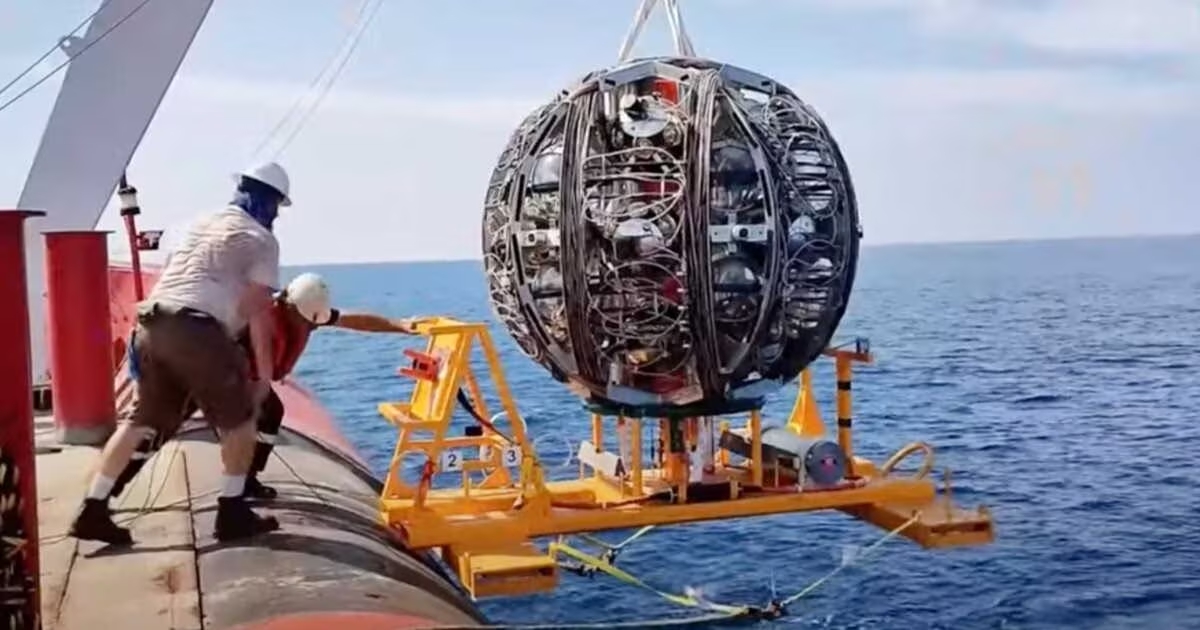
The KM3NeT collaboration, a consortium of over 250 scientists from 18 countries, operates two deep-sea neutrino telescopes: ARCA (Astroparticle Research with Cosmics in the Abyss) off the coast of Sicily, Italy, and ORCA (Oscillation Research with Cosmics in the Abyss) near Toulon, France. The recent detection was made by the ORCA detector. These observatories are designed to detect the faint flashes of light (Cherenkov radiation) produced when neutrinos interact with water molecules, transforming the deep ocean into a giant particle detector.
How Deep-Sea Neutrino Telescopes Work
The ORCA detector, specifically, is optimized to study atmospheric neutrinos and determine the neutrino mass hierarchy. It consists of a lattice of Digital Optical Modules (DOMs) anchored to the seabed, each containing highly sensitive photomultiplier tubes. When a neutrino interacts with water, it produces charged particles that travel faster than the speed of light in water, emitting a cone of Cherenkov light. The DOMs detect this light, and sophisticated algorithms reconstruct the neutrino’s direction and energy. The deep-sea location is crucial as it shields the detectors from cosmic ray backgrounds that constantly bombard Earth’s surface.
Tracing the Cosmic Traveler’s Origin
The detected neutrino, with an estimated energy of several teraelectronvolts (TeV), was traced back to a region of the sky consistent with the active galaxy NGC 1068, also known as Messier 77. This spiral galaxy, located approximately 47 million light-years away in the constellation Cetus, is renowned for its active galactic nucleus (AGN). AGNs are supermassive black holes at the centers of galaxies that actively accrete matter, releasing enormous amounts of energy across the electromagnetic spectrum.
Active Galactic Nuclei as Neutrino Factories
Scientists hypothesize that AGNs are powerful accelerators of cosmic rays and neutrinos. The intense gravitational and magnetic fields around the central black hole can accelerate particles to extreme energies. When these high-energy particles interact with surrounding gas and dust, they produce neutrinos. The precise correlation between the neutrino’s arrival direction and NGC 1068 strengthens the theory that AGNs are indeed significant sources of these cosmic messengers.
Implications for High-Energy Astrophysics
This detection provides compelling evidence for the hadronic processes occurring within NGC 1068, where protons are accelerated to high energies and interact to produce neutrinos. Previously, such associations between high-energy neutrinos and specific astrophysical sources were rare. The IceCube Neutrino Observatory at the South Pole has also made significant contributions, but KM3NeT’s unique location and design offer complementary insights, particularly for neutrinos arriving from the Northern Hemisphere.
The Future of Neutrino Astronomy
The successful operation of KM3NeT and the groundbreaking results it yields underscore the immense potential of deep-sea neutrino astronomy. As the KM3NeT detectors continue to expand, their sensitivity will increase, allowing for the detection of more neutrinos and a more detailed mapping of the high-energy universe. This will enable scientists to:
- Pinpoint more cosmic ray sources: Identifying the origins of the highest-energy particles in the universe.
- Probe extreme environments: Studying the physics of black holes, supernovae, and other energetic cosmic events.
- Test fundamental physics: Investigating the properties of neutrinos and the Standard Model of particle physics under extreme conditions.
Key Takeaways
- An ultra-high-energy neutrino was detected by the KM3NeT ORCA telescope at 2,450 meters deep in the Mediterranean Sea.
- This ‘ghost particle’ originated from the active galactic nucleus of NGC 1068, a spiral galaxy 47 million light-years away.
- The discovery provides strong evidence that active galactic nuclei are significant sources of high-energy cosmic neutrinos.
- KM3NeT’s deep-sea location offers unique advantages for neutrino detection, shielding from cosmic ray interference.
- This achievement marks a major advancement in high-energy astrophysics, opening new avenues for understanding the universe’s most extreme phenomena.
Conclusion: A New Era of Cosmic Exploration
The detection of this extraordinary particle from the farthest reaches of the universe by the KM3NeT observatory represents a pivotal moment in astronomy. It not only confirms theoretical predictions about the origins of cosmic neutrinos but also inaugurates a new era of multi-messenger astronomy, where different cosmic signals—light, gravitational waves, and neutrinos—are combined to paint a more complete picture of the universe. As the KM3NeT project continues to evolve and expand, the scientific community anticipates even more profound discoveries, further illuminating the mysteries of the cosmos from the serene depths of our own planet’s oceans. This ongoing research promises to deepen our understanding of the fundamental forces that shape the universe and the incredible phenomena that unfold within it.
Original author: Dr. Rosalia Neve
Originally published: October 20, 2025
Editorial note: Our team reviewed and enhanced this coverage with AI-assisted tools and human editing to add helpful context while preserving verified facts and quotations from the original source.
We encourage you to consult the publisher above for the complete report and to reach out if you spot inaccuracies or compliance concerns.