Critical Relief: China Lifts Key Export Restrictions on Essential Automotive Components
In a significant move aimed at stabilizing global manufacturing supply chains, China’s Ministry of Commerce (MOFCOM) has announced the exemption of certain computer chips produced by Nexperia from its export control regime. These components are considered vital for the global automotive industry, and the decision is expected to provide immediate relief to car manufacturers worldwide who rely heavily on a steady supply of these essential semiconductors.
The exemption, confirmed by Chinese authorities, targets chips that are crucial for power management and various analog functions within vehicles. This decision underscores China’s strategic interest in maintaining the stability of the global industrial chain, particularly in sectors where supply bottlenecks have caused severe disruptions in recent years.

Understanding the Scope: What Chips Are Affected?
The chips covered by this exemption are primarily mature-node semiconductors—often referred to as legacy chips—which are essential for the fundamental operation of modern vehicles, from managing battery power to controlling sensors and infotainment systems. While the geopolitical focus often centers on cutting-edge chips (like those used for AI and advanced computing), these mature components are the workhorses of the automotive sector.
Nexperia, the company producing these chips, is a Netherlands-based global semiconductor manufacturer specializing in essential components, including:
- Diodes and Transistors: Used for switching and signal processing.
- Logic Devices: Crucial for basic control functions.
- MOSFETs (Metal-Oxide-Semiconductor Field-Effect Transistors): Essential for power management and efficiency.
These components, while not the most technologically advanced, are required in massive volumes by every major global automaker. Disruptions in their supply can halt entire production lines, as demonstrated during the severe chip shortage that began in 2020.
The Nexperia-Wingtech Connection
The reason Nexperia’s products were subject to Chinese export controls is rooted in its ownership structure. Nexperia, which was spun off from NXP Semiconductors, is currently owned by Wingtech Technology, a major Chinese technology conglomerate. This ownership places Nexperia under the jurisdiction of Chinese regulatory bodies regarding export policies, making the MOFCOM exemption a necessary step to ensure continued global distribution.
The decision to exempt these specific components reflects a targeted effort by Beijing to differentiate between strategic, high-end technology subject to international scrutiny and the essential, high-volume components required for stable global manufacturing.
Geopolitical Context and Market Implications
This move comes amid heightened global tensions surrounding semiconductor technology. The United States and the European Union have implemented strict controls on the export of advanced chip-making equipment and technology to China, aiming to slow Beijing’s progress in developing cutting-edge processors.
China’s reciprocal action, or in this case, a targeted relaxation of controls, serves several strategic purposes:
- Stabilizing Key Industries: By ensuring the flow of essential components, China supports the global automotive sector, a massive consumer of Chinese-produced goods and components.
- Demonstrating Reliability: It signals to international partners that China is committed to maintaining its role as a reliable supplier of critical components, contrasting with the narrative of supply chain risk.
- Strategic Differentiation: It clearly separates the mature-node market, where China holds significant manufacturing capacity, from the advanced-node market, which is the focus of Western export restrictions.
Relief for Global Automakers
The automotive industry has struggled significantly with supply chain volatility. The availability of power management integrated circuits (PMICs) and microcontroller units (MCUs) has often dictated production volumes. The exemption of Nexperia’s chips is viewed as a positive development that reduces the risk of future, politically motivated supply interruptions.
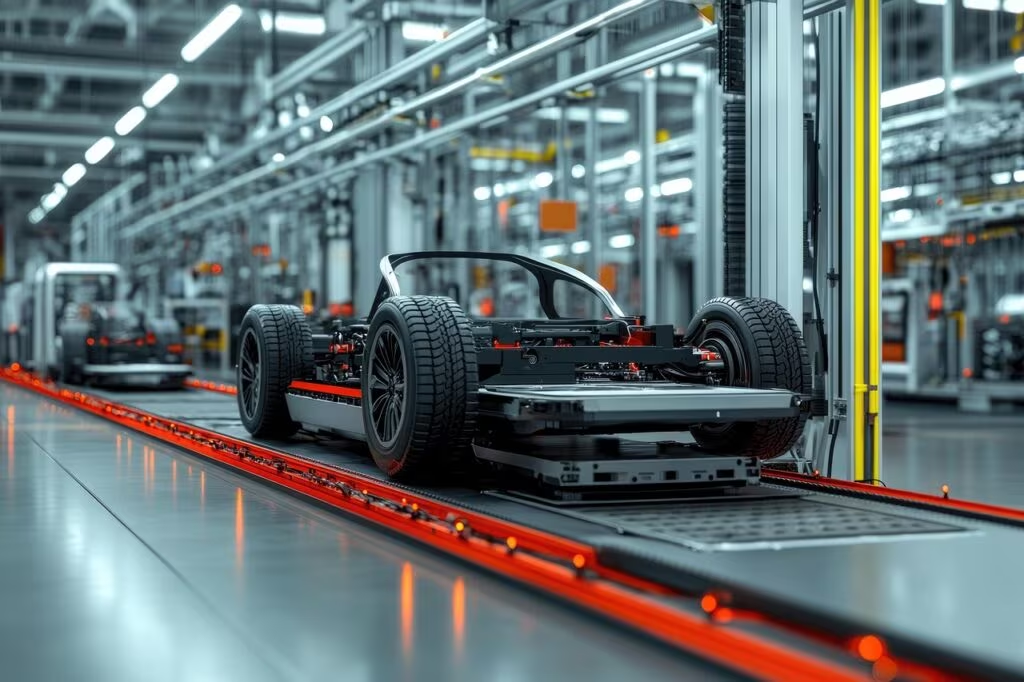
This stability is crucial for manufacturers planning their production schedules for the remainder of 2025 and beyond, particularly as the industry transitions toward electric vehicles (EVs), which require even more complex power electronics.
Broader Implications for Global Tech Trade
While this exemption is specific to Nexperia and the automotive sector, it provides insight into China’s evolving strategy regarding technology exports. Instead of broad, sweeping controls, Beijing appears to be adopting a more nuanced approach, balancing national security interests with the necessity of participating in and stabilizing global commerce.
| Semiconductor Type | Geopolitical Focus | Impact of Nexperia Exemption |
|---|---|---|
| Advanced Nodes | US/EU Export Controls | High tension; focus on AI/CPUs |
| Mature Nodes | Supply Chain Stability | Lowers risk; supports global manufacturing |
| Nexperia Products | Essential Automotive | Direct and immediate positive impact |
Experts suggest that this move could be a precursor to further targeted adjustments in China’s export policies, especially concerning components that are critical to international partners but do not pose a direct threat to national security or technological parity in advanced computing.
Anticipating Future Policy
The MOFCOM announcement confirms that China is actively managing its technology trade levers. For companies operating in China or relying on Chinese-made components, the key takeaway is the necessity of closely monitoring these targeted policy shifts, which can rapidly alter supply chain risk profiles.
Key Takeaways
This targeted exemption by China’s Ministry of Commerce offers crucial stability to a major global industry. The essential points for business leaders and analysts are:
- Targeted Exemption: China has lifted export controls specifically on chips manufactured by Nexperia, which is owned by Wingtech Technology.
- Automotive Focus: These chips are vital, mature-node components used for power management and analog functions in vehicles.
- Supply Chain Relief: The move significantly eases potential supply bottlenecks and reduces geopolitical risk for global car manufacturers.
- Strategic Policy: The exemption signals China’s intent to stabilize global industrial chains, particularly where its components are indispensable, while maintaining controls on more sensitive, advanced technologies.
- Market Stability: This decision is a positive indicator for the automotive sector’s production outlook for 2025.
Conclusion: A Calculated Step Toward Stability
China’s decision regarding Nexperia chips is not merely a technical adjustment; it is a calculated geopolitical and economic maneuver. By ensuring the smooth flow of these essential components, Beijing addresses immediate global supply concerns while reinforcing its position as a critical node in the world’s manufacturing network. For the global automotive industry, this exemption translates directly into greater predictability and reduced operational risk, allowing manufacturers to focus on innovation rather than component scarcity.
Originally published: November 10, 2025
Editorial note: Our team reviewed and enhanced this coverage with AI-assisted tools and human editing to add helpful context while preserving verified facts and quotations from the original source.
We encourage you to consult the publisher above for the complete report and to reach out if you spot inaccuracies or compliance concerns.