Breakthrough Observation Reveals Complex Structure of Interstellar Object 3I/ATLAS
Astrophysicist Avi Loeb of Harvard University has released detailed findings concerning the structure of the interstellar object designated 3I/ATLAS, revealing a complex and “remarkable” large-scale morphology involving both a traditional tail and an anti-tail jet system. The observations, captured in early November 2025, provide critical new data on the activity and composition of objects originating outside our solar system.
The findings stem from a deep stacked image captured on November 9, 2025, between 5:08 and 5:22 UT. This high-resolution composite image, created using a combination of five exposures, each lasting three minutes, and utilizing two separate telescopes, allowed researchers to resolve the faint, extended structures surrounding the fast-moving visitor.

This detailed view of 3I/ATLAS—the third confirmed or suspected interstellar object—emphasizes the object’s active nature, suggesting it is undergoing significant outgassing as it traverses the inner solar system. The simultaneous presence and distinct structure of the tail and anti-tail jets offer unique insights into the object’s rotation, composition, and the physics governing its interaction with solar radiation.
The Anatomy of 3I/ATLAS: Tails and Anti-Tails Explained
For an object like 3I/ATLAS to display both a tail and an anti-tail, it must be actively shedding material, a process known as sublimation, typical of comets. However, the specific geometry and clarity of the structures observed by Loeb and his team are what define them as “remarkable.”
The Standard Cometary Tail
The primary tail (or Type I/II tail) is formed when volatile materials (ices like water, carbon dioxide, or methane) sublimate upon approaching the Sun. This ejected material is then pushed away from the Sun by solar wind and radiation pressure. Consequently, the main tail always points away from the Sun, regardless of the object’s direction of travel.
The Phenomenon of the Anti-Tail
The anti-tail is a less common and often misunderstood feature. It appears to point sunward (towards the Sun), which is counter-intuitive. This effect is typically not a true jet of material moving toward the Sun, but rather an optical projection effect.
- Mechanism: The anti-tail consists of larger, heavier dust particles that are too massive to be immediately swept away by solar radiation pressure. These particles lag behind the nucleus but remain roughly in the object’s orbital plane.
- Observation: When Earth’s viewing geometry aligns such that we are looking almost edge-on into the orbital plane, these lagging particles are projected in front of the nucleus, creating the illusion of a tail pointing toward the Sun.
The observation of a clear, large-scale anti-tail in 3I/ATLAS indicates a significant release of large, heavy dust grains, suggesting a robust and perhaps unusual composition compared to typical solar system comets.
Detailed Observational Data and Methodology
The ability to capture the faint, extended structures of 3I/ATLAS required specialized deep-stacking techniques. The use of two telescopes simultaneously allowed for the collection of more photons over a shorter period, minimizing the effects of atmospheric turbulence and maximizing the signal-to-noise ratio.
Key details of the observation:
- Date: November 9, 2025
- Total Integration Time: 15 minutes (5 exposures x 3 minutes)
- Instrumentation: Two separate, high-sensitivity telescopes (specific instrumentation details were not provided in the initial release but are implied to be professional-grade)
- Result: A stacked deep image that clearly resolved the large-scale structure of both the tail and the sunward-pointing anti-tail.
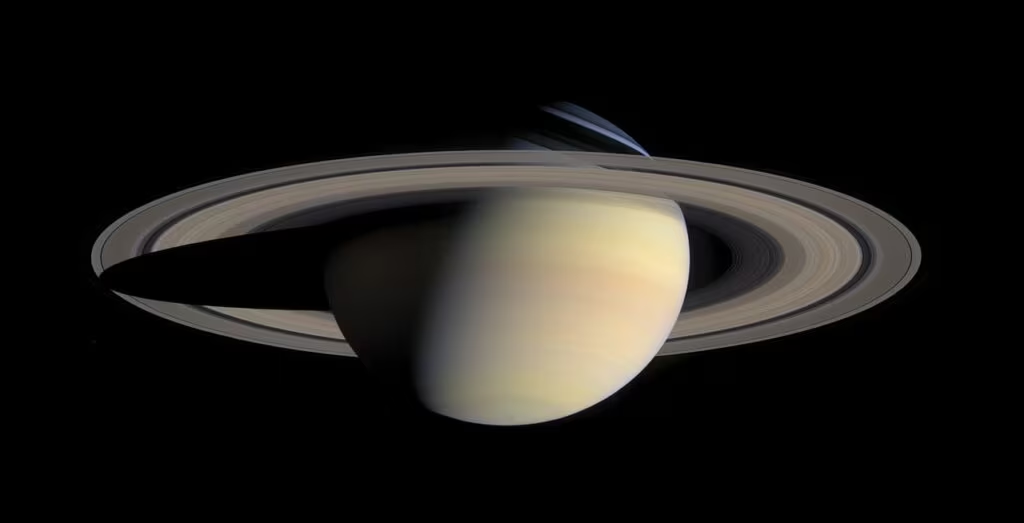
Loeb noted that the sunward direction was clearly aligned with the anti-tail structure, confirming the projection effect of the heavier dust particles. The overall length and distinct separation of the two structures suggest a highly collimated, perhaps localized, source of outgassing on the nucleus of 3I/ATLAS.
Implications of the Dual Jet Structure for Interstellar Composition
Avi Loeb’s analysis focuses on the implications of this dual jet structure for understanding the object’s origin. The presence of both features suggests intense, focused activity, which could be driven by several factors:
1. Non-Gravitational Acceleration
Just as with the previously studied interstellar object ‘Oumuamua, the localized jets could be causing non-gravitational acceleration—a slight push that deviates the object from a purely gravitational orbit. The precise measurement of the jet structures is crucial for modeling this acceleration and determining the nature of the sublimating material.
2. Compositional Clues
The clarity of the anti-tail, composed of heavier dust, suggests that 3I/ATLAS may have formed in a region of its home star system where larger, less volatile grains were abundant. The ratio of light volatile material (driving the main tail) to heavy dust (forming the anti-tail) provides a chemical fingerprint of its distant origin.
3. Rotation and Morphology
The direction and stability of the jets over the observation period can be used to infer the rotation rate and axis of the nucleus. If the jets are stable and highly localized, it implies that the volatile materials are concentrated in specific regions or fissures on the surface, which are being exposed to solar heating as the object rotates.
“The remarkable large-scale structure we observed in 3I/ATLAS challenges our standard models of cometary activity, especially for objects that formed outside the Sun’s influence,” Loeb stated in his analysis. “The clarity of the anti-tail, in particular, suggests a significant population of large dust grains, which is a key piece of evidence for reconstructing its formation environment.”
Key Takeaways from the 3I/ATLAS Observation
The November 2025 observations of 3I/ATLAS provide essential data points in the ongoing study of interstellar visitors:
- Active Interstellar Object: 3I/ATLAS is confirmed to be highly active, undergoing significant sublimation and outgassing as it passes through the inner solar system.
- Dual Structure Confirmation: The object clearly displays both a traditional tail (pointing away from the Sun) and a prominent anti-tail (appearing to point toward the Sun).
- Heavy Dust Content: The distinct anti-tail indicates the presence of a substantial amount of large, heavy dust particles, offering clues about the object’s formation and composition.
- Advanced Imaging: The use of stacked, multi-telescope exposures was essential for resolving the faint, large-scale structures, demonstrating the necessity of high-sensitivity techniques for these transient objects.
- Potential for Non-Gravitational Effects: The localized jet activity suggests the object may be experiencing non-gravitational acceleration, a factor critical for accurately predicting its trajectory.
The Continuing Search for Interstellar Visitors
Since the discovery of 1I/’Oumuamua in 2017 and 2I/Borisov in 2019, the scientific community has intensified efforts to detect and characterize these interstellar interlopers. Objects like 3I/ATLAS are invaluable because they represent pristine samples of material from other star systems, offering a direct window into exoplanetary formation processes.
Future research will focus on spectroscopic analysis of the jets to identify the specific volatile compounds being released, which will further constrain the object’s origin. As 3I/ATLAS continues its hyperbolic trajectory out of the solar system, these early, high-resolution observations led by Avi Loeb will remain the definitive data set for understanding its remarkable, large-scale structure.
Original author: Avi Loeb
Originally published: November 9, 2025
Editorial note: Our team reviewed and enhanced this coverage with AI-assisted tools and human editing to add helpful context while preserving verified facts and quotations from the original source.
We encourage you to consult the publisher above for the complete report and to reach out if you spot inaccuracies or compliance concerns.