The Ultimate Test of Patience: Capturing the Arctic Ambush
One of the most dramatic and rarely witnessed events in the natural world—the ambush hunt of a polar bear—was captured in stunning detail by a BBC film crew for the series The Hunt. Narrated by the iconic Sir David Attenborough, the footage provides an intimate look at the extreme patience and sudden, ferocious power required for the Arctic predator to survive.
The sequence, filmed in the remote Norwegian Arctic, highlights the immense challenges facing the world’s largest land carnivore. Unlike many predators that rely on speed or teamwork, the solitary polar bear (Ursus maritimus) must often employ a strategy of absolute stillness, waiting for hours or even days for a single opportunity to strike.
The Aglu Strategy: Waiting for the Breath of Life
The footage focuses on the polar bear’s primary hunting technique for seals during the winter months: the aglu ambush. An aglu is a small breathing hole maintained in the sea ice by seals, primarily the ringed seal (Pusa hispida), which is the polar bear’s most common prey. These holes are vital lifelines for the seals, but they also represent a fatal vulnerability.
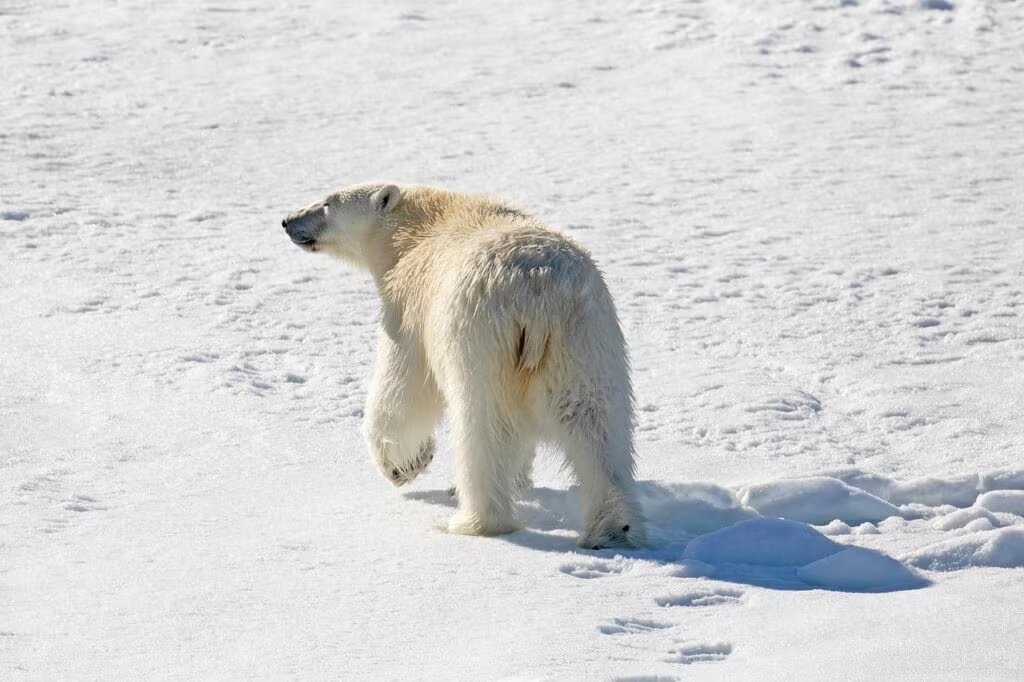
For the bear, this strategy is a grueling exercise in endurance. The bear must locate an active aglu and then settle downwind, remaining completely motionless and silent. The success of the hunt depends entirely on the seal’s need for air and the bear’s ability to wait out its prey.
When a ringed seal, described in the narration as “trembling” and “terrified,” finally surfaces to breathe, the bear must execute a flawless, explosive attack. The footage captures the critical moment as the bear launches its massive body, using its:
- Immense Weight: The bear’s weight, which can exceed 200 kilograms (440 lbs) for a female and much more for a male, is used as a weapon.
- Powerful Paws: The bear smashes its large, heavy paws through the layer of ice covering the hole.
- Precision: The strike must be immediate and accurate to prevent the seal from escaping back into the water.
This dramatic sequence underscores the brutal reality of Arctic survival, where a single successful hunt can mean the difference between life and death for the bear.
The Low Success Rate of the Arctic Hunter
While the footage captures a successful kill, it is crucial to understand the rarity of such moments. Polar bears are notoriously inefficient hunters. Studies of their foraging behavior indicate that they achieve a successful kill only about one time in every 20 hunts.
This low success rate is why the bear’s patience is not merely a virtue but a necessity. Every calorie expended in a failed hunt is a drain on its limited energy reserves, making the successful capture of a high-fat seal essential for long-term survival, especially during periods of food scarcity.
The Challenges of Wildlife Filmmaking
Capturing this intimate and intense moment required extraordinary dedication and technical skill from the BBC production team. To film the bear without disturbing its natural behavior, the crew had to employ extreme camouflage and maintain absolute silence.

The crew observed the bear’s vigil for an astonishing 13 days before the successful ambush occurred. To get the close-up, visceral shots of the attack, they utilized a remote camera positioned near the aglu, allowing them to capture the bear’s focused intensity and the seal’s vulnerability without interference.
This level of commitment highlights the increasing difficulty of documenting these elusive predators, particularly as their environment changes.
Context in a Changing Climate
While the footage celebrates the polar bear’s mastery of its environment, it also serves as a poignant reminder of the fragility of the Arctic ecosystem in 2025. The hunting strategy documented—relying on stable, thick sea ice to create and maintain the aglu—is increasingly threatened by climate change.
Key Implications for Polar Bear Survival:
- Reduced Hunting Platform: Earlier and more extensive melting of sea ice reduces the time polar bears have to hunt seals effectively.
- Increased Energy Expenditure: Bears are forced to swim longer distances or travel further to find stable ice, burning crucial fat reserves.
- Fewer Ambush Opportunities: Unstable or thin ice makes the aglu ambush technique less viable, forcing bears to rely on less successful methods.
The patience and precision demonstrated by the bear in the BBC footage are traits honed over millennia of evolution. However, these adaptations are increasingly challenged by the rapid environmental shifts occurring in the Arctic, making the documentation of these traditional hunting behaviors more critical than ever for conservation efforts.
Key Takeaways
This extraordinary footage, narrated by Sir David Attenborough, provides crucial insights into the survival mechanics of the polar bear:
- Low Efficiency: Polar bears succeed in only about one out of every 20 hunts, necessitating extreme patience.
- The Aglu Technique: The primary hunting method involves waiting silently by a seal’s breathing hole in the ice.
- Physical Power: The bear uses its 200kg+ weight and powerful paws to smash through the ice and secure the ringed seal.
- Filming Dedication: The BBC crew spent 13 days observing the bear in the Norwegian Arctic to capture the successful ambush using remote cameras.
- Conservation Context: The entire hunting strategy is dependent on stable sea ice, which is rapidly diminishing due to climate change.
Conclusion
The footage of the polar bear’s ambush is more than just a dramatic wildlife spectacle; it is a profound lesson in survival strategy. It showcases the incredible commitment of a predator that must balance hours of absolute stillness with moments of explosive violence. As the Arctic environment continues to evolve, the documentation of these complex, high-stakes hunting behaviors, made possible by dedicated filmmakers and narrated by authoritative voices like Attenborough, remains vital for understanding and protecting these magnificent, yet vulnerable, animals.
Original author: Freya Parr
Originally published: November 10, 2025
Editorial note: Our team reviewed and enhanced this coverage with AI-assisted tools and human editing to add helpful context while preserving verified facts and quotations from the original source.
We encourage you to consult the publisher above for the complete report and to reach out if you spot inaccuracies or compliance concerns.