Rewriting History: New Evidence Challenges the Myth of Akhenaten’s Plague
For decades, one of the most enduring narratives surrounding the collapse of Akhetaten—the revolutionary capital founded by Pharaoh Akhenaten—has been the theory of a devastating epidemic. Historians often cited a localized plague as the catastrophic event that rapidly depopulated the city, contributing to the swift end of the entire Amarna Period in the mid-14th century BCE.
However, a rigorous new study conducted by archaeologists and epidemiologists has fundamentally challenged this long-held belief. By comparing the archaeological record of Akhetaten (modern Amarna) with sites definitively known to have suffered major ancient epidemics, researchers conclude that the evidence simply does not support the occurrence of a localized, catastrophic plague in the city itself.
This finding shifts the focus away from disease as the primary cause of Akhetaten’s abandonment, forcing a re-evaluation of the political and religious factors that truly led to the downfall of Akhenaten’s utopian experiment.
The Amarna Experiment: A Capital Built on Revolution
Akhetaten was established by Pharaoh Akhenaten (originally Amenhotep IV) around 1346 BCE. It was a radical departure from traditional Egyptian governance, built from scratch to serve as the center for Akhenaten’s monotheistic worship of the sun disk, Aten. The city was constructed rapidly and housed an estimated 20,000 to 50,000 inhabitants during its brief 15-year lifespan as the nation’s capital.

The city’s sudden abandonment shortly after Akhenaten’s death has always required a compelling explanation. The traditional theory suggested that a massive epidemic—often referred to as the ‘Plague of Akhetaten’—swept through the densely populated, newly built city, causing widespread death and making the site politically and religiously untenable for subsequent rulers.
This theory was often supported by textual evidence from the era, which certainly confirms that plagues were circulating in the wider Near East during the Late Bronze Age. However, the new research focused on whether these regional outbreaks actually manifested as a devastating local epidemic within the city walls of Akhetaten.
Epidemiological Markers: What a True Ancient Plague Site Looks Like
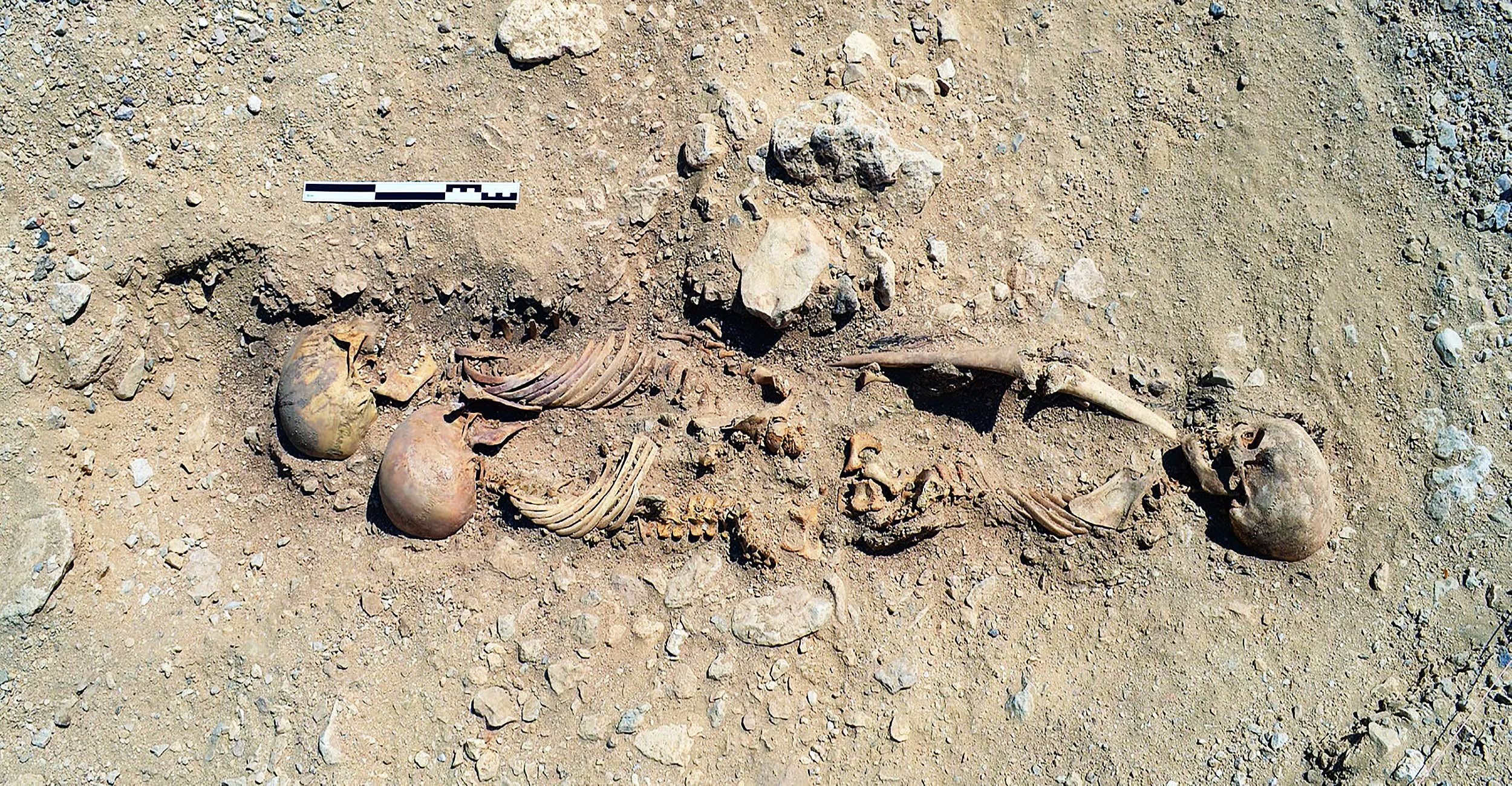
To test the plague hypothesis, the research team established a baseline by analyzing the archaeological signatures left behind at sites known to have been ravaged by major epidemics, such as the Plague of Justinian or the Black Death.
True catastrophic epidemics leave distinct, measurable epidemiological markers in the archaeological record, particularly in burial practices and demographic profiles. These markers include:
- Mass Graves: The necessity for rapid, mass burial due to the overwhelming number of dead, often without the usual funerary rites or individual coffins.
- Demographic Profile: High mortality rates across all age groups, including robust young adults and children, indicating a swift, non-selective killer.
- Sudden Cessation of Activity: An abrupt halt in construction, trade, and daily life, reflected in unfinished buildings and abandoned workshops.
- Disrupted Burial Practices: Evidence of hurried, shallow, or irregular burials, often within the city limits rather than established cemeteries.
The Evidence from Amarna: A Lack of Catastrophe
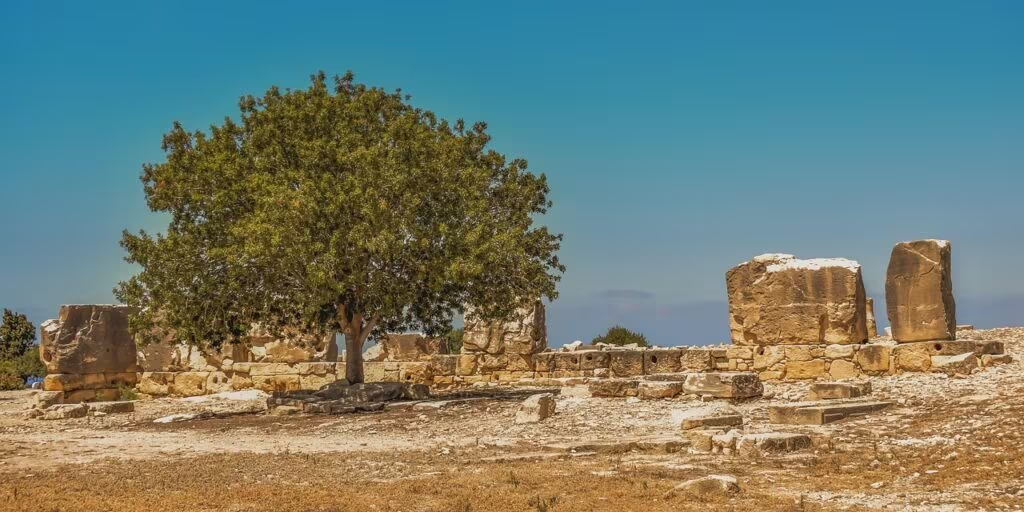
The researchers meticulously compared the burial records and population patterns of Akhetaten against these established epidemiological markers. The findings revealed a significant disconnect between the historical myth and the physical evidence on the ground.
Burial Practices
Unlike sites devastated by plague, the cemeteries surrounding Akhetaten, such as the North Tombs and the South Tombs, do not show evidence of mass, indiscriminate burial. While the graves certainly reflect a population under stress—likely due to poor diet, hard labor, and endemic diseases common in ancient Egypt—they do not suggest a sudden, overwhelming mortality event.
“The burial patterns observed at Akhetaten are consistent with a typical ancient urban population struggling with high infant mortality and common endemic diseases, but they lack the signature of a swift, catastrophic epidemic that would wipe out a significant percentage of the population in a short period,” the researchers noted.
Demographic Profile
Analysis of the skeletal remains does not show the characteristic demographic shift expected from a plague. While mortality was high, it was concentrated among the most vulnerable groups—infants, young children, and the elderly—a pattern typical of endemic, non-catastrophic diseases and poor living conditions, not a rapid, indiscriminate plague.
City Abandonment
Furthermore, the abandonment of Akhetaten was not instantaneous. Archaeological evidence suggests a gradual winding down of activity, followed by the systematic dismantling and removal of valuable materials (statues, blocks, furniture) by subsequent regimes, particularly during the reign of Tutankhamun and Horemheb. This organized dismantling contradicts the idea of a city suddenly abandoned due to panic and mass death.
Implications: Rewriting the Fall of Amarna
The debunking of the localized plague myth means that the explanation for Akhetaten’s collapse must return to the political and religious spheres.
If disease did not force the abandonment, then the city’s demise was almost certainly a deliberate, political act. Akhenaten’s religious revolution—the shift to Aten worship—was deeply unpopular with the powerful traditional priesthood of Amun and much of the populace.

The new consensus suggests that immediately following Akhenaten’s death, powerful figures within the court and military, seeking to restore stability and the traditional Amun cult, systematically dismantled the capital and erased the memory of the Amarna heresy. The city was not emptied by sickness but by political decree and religious backlash.
This research provides critical insight for the field of ancient history, demonstrating the necessity of grounding historical narratives in rigorous epidemiological and archaeological data, rather than relying solely on dramatic textual interpretations.
Key Takeaways
The new archaeological findings offer a clearer picture of the final days of Akhetaten, emphasizing political upheaval over public health disaster:
- Myth Debunked: The long-standing belief that a catastrophic, localized plague caused the abandonment of Akhetaten is not supported by archaeological evidence.
- Methodology: Researchers used rigorous epidemiological comparison, contrasting Akhetaten’s burial sites with those of known ancient plague zones.
- Lack of Markers: Akhetaten’s cemeteries lack the key markers of a major epidemic, such as mass graves and high mortality across all adult age groups.
- True Cause: The city’s demise was likely due to political and religious backlash following Akhenaten’s death, leading to the systematic dismantling and relocation of the capital.
- Historical Context: While regional plagues existed in the Near East, the evidence shows they did not manifest as a localized catastrophe that destroyed Akhetaten itself.
Originally published: November 7, 2025
Editorial note: Our team reviewed and enhanced this coverage with AI-assisted tools and human editing to add helpful context while preserving verified facts and quotations from the original source.
We encourage you to consult the publisher above for the complete report and to reach out if you spot inaccuracies or compliance concerns.